
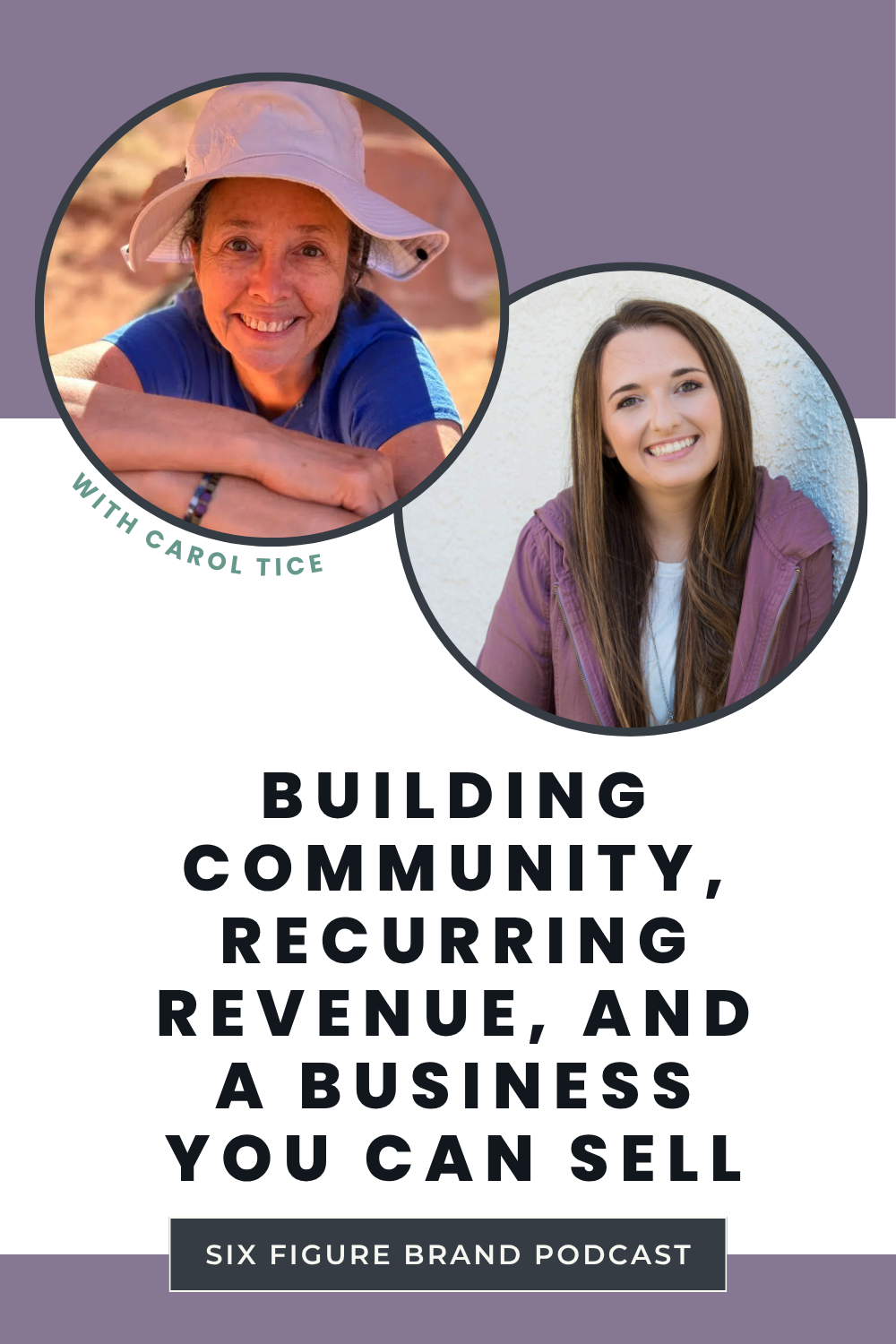
Ep. 79 Building Community, Recurring Revenue, and a Business You Can Sell w/ Carol Tice
Most online service providers spend their entire career asking the same questions: how do I get more clients, how do I get more visibility, how do I grow my team? But what if the better question is how do I build something that doesn't depend entirely on me?
Carol Tice did exactly that. She built Freelance Writers Den, a membership community that grew to 1,500 paying members, generated reliable recurring revenue for twelve years, and then sold for multi-six figures in 2021. She now lives and works full-time from a van, travels extensively, and has channeled everything she learned from building and selling her community into a new venture called Community Growth Academy.
In this conversation, Carol and I got into the power of the community model, why it's one of the most underrated business structures for online service providers, and what you actually need to know if you ever want to build something valuable enough that someone else might want to buy it one day.
Or listen on your favorite platform: Spotify | Apple Podcasts | Amazon Music | YouTube
Carol's Story: Laid Off, Then Accidentally Built a Business
Carol started as a staff journalist, got laid off, went back to freelancing, and started blogging about the experience. She discovered she loved having her own publish button after years of working through editors and gatekeepers, and eventually stumbled into a paid community for bloggers called the A-List Blogger Club.
The moment she joined, she had a clear thought: there's nothing like this for freelance writers, and there should be. A conference, a survey of her existing audience, a tech person to help set things up, and ninety days later Freelance Writers Den was live. She hadn't planned to build a business. She just saw a gap and moved toward it.
The Den grew to 1,500 members. Around the thousand-member mark, she started getting approached about selling. She wasn't interested at first. By the third time someone asked, she started paying attention.
Why Community Is One of the Best Business Models for Service Providers
Carol walked through several reasons the community model stands apart from coaching, consulting, and done-for-you services.
Recurring revenue over feast and famine. When Carol launched the Den, her husband had developed a seizure disorder and they'd recently adopted an unexpected third child. Down months weren't an option for her family. The membership model meant money came in every single month regardless of whether she was actively selling anything. Over twelve years, she says they never had to worry.
Multiple revenue levers. When revenue started to trend down, Carol could launch a new course, run a sale on archived content, or bundle old expert calls and sell them off the shelf. You're not dependent on one income stream or one client contract.
Leverage over time. A course or training you create once can help people for years. Carol still gets messages on LinkedIn from people saying they just joined the Den and took a class that changed their business, years after she sold it and moved on. If you want to build something with a real legacy, community is a strong vehicle for that.
You become less necessary over time. This is the part that's also key to eventually selling. When you run a coaching business named after yourself, there's no exit. You are the product. When you're ready to stop, you close the doors and walk away with nothing. A community, built well, can outlast you. Carol had volunteer moderators, paid staff, guest experts who taught courses, and systems that meant the business wasn't dependent on her presence.
It solves the trust crisis. Carol spent $6,000 on a professional Facebook ad campaign to launch Community Growth Academy and it converted zero. Nobody clicked. We've all gotten skeptical enough of the internet that even well-run ads from experienced teams aren't landing the way they used to. Community works differently. People get to know you, talk to you, and see that you're real over time. That's a much harder thing to fake.
Community Is Not Passive Income
This deserves its own section because the word passive gets thrown around constantly in the membership world and it's simply not accurate.
Carol is emphatic about this. She calls it recurring revenue, not passive income, and the distinction matters. You're building value constantly: new courses, new events, new connections, new content. The community gets more valuable over time, but that value doesn't appear on its own.
What the model does offer is leverage. You create something once and it keeps helping people. You're not selling hours. But you're still working, still iterating, still showing up.
You Don't Have to Be the Only Expert in the Room
One of the biggest things that stops people from starting a community is the belief that they have to know everything or be the authority on every topic. Carol's experience, and mine with the Six Figure Brand Society, is that this is both untrue and counterproductive.
Carol brought in guest experts to teach courses on topics outside her expertise. Half the classes in the Den were taught by other people. And here's the thing: that actually made the business more sellable, because a buyer could look at it and see that the whole thing wasn't dependent on Carol alone. There were substitute teachers in the classroom.
For me, the Six Figure Brand Society is about building a sustainable six-figure brand. I can teach brand strategy, design, and web design. But sales, copywriting, marketing, finances, mindset? I bring in experts for that. My members get more value than I could deliver alone, and the community is stronger for it.
If you've been holding back on starting a community because you feel like you don't know enough, that's not actually the problem you think it is.
How to Find Your Community Idea
Carol's advice here isn't to start from an idea in your head. It's to look outward.
What are people in your world consistently frustrated by? What questions do they keep asking you? What are you seeing that isn't being done well in your industry? What gap exists that someone with your background could fill?
She gives a great example from a student in Community Growth Academy who launched a community for people who do marketing for home remodeling businesses. What she noticed was that the people actually doing the marketing were almost always women, and almost all of the training and resources available were created by men. She found a gap in positioning, not just in topic, and built around that.
Carol also makes a point that's easy to miss: a community works best in a space that's dynamic and changing. If your industry is totally static, a course on Teachable with a funnel pointing to it might be enough. But freelance writing, branding, marketing, creative business — these things keep evolving. Members stay because they feel like they're keeping up, not just learning a fixed curriculum.
And before you build anything: ask people what they want. Carol surveyed her audience before she launched. Every course the Den ever made was chosen by polling members on which of three options they most wanted. They never had a course lose money. Compare that to my early experience of spending weeks building a DIY logo course that nobody asked for, selling four copies, and watching zero of them ever convert to paid clients. The lesson writes itself.
How to Think About Selling Your Business
This is the part most online business owners have never thought about, and Carol thinks that's a problem.
A lot of us don't think past the excitement of being our own boss. We don't have an exit plan. We don't have a retirement strategy. And we've built businesses that, when we're done, we simply close. A friend of Carol's with just as much expertise and a strong community just shut it all down and walked away with nothing.
You don't have to sell next year. But if there's any chance you might want to sell eventually, you need to start thinking about it now.
Here's what Carol learned about how buyers think.
They care about monthly recurring revenue above almost everything else. Predictable, consistent revenue tells a buyer the business can continue without you. Consulting revenue that fluctuates based on client contracts is much harder to sell around.
They care about how many hours you work in the business. They're going to ask. And they want the answer to be small, because that workload is going to fall on them or someone they have to pay. Start replacing yourself in roles long before you think about selling.
They think in multiples of net profit. Businesses aren't sold based on gross revenue. They're sold based on what you actually net after expenses, multiplied by a factor that reflects the type and stability of the business. For Carol's community at the time of sale, that multiple was roughly three to four times annual net. She did the math, saw that a thousand members wasn't going to produce the number she wanted, and grew the business 50% before selling.
They want your stats. What's your average member lifetime? What's your churn rate? What's the lifetime value of a customer? What does your monthly profit and loss look like? Carol was doing her taxes once a year and celebrating that the lifestyle was great. Buyers want monthly data going back years. Start tracking now, even if a sale is a decade away.
They want a business that isn't scattered. Carol had multiple LLCs, a separate coaching offer, a small group program that depended entirely on her being the coach. A business consultant pointed out that none of those revenue streams would survive the sale. They spent significant time cleaning things up before going to market.
The Timing of a Sale Matters
Carol sold in the depths of COVID when people were getting laid off in large numbers. A lot of those people decided they wanted to become freelance writers. Membership was growing. The numbers looked great. It was a good moment to sell, even though it was also a strange and anxious time to be doing it.
She'd been approached about selling three times before she finally moved forward. She's glad she didn't sell the first time. She's also glad she didn't wait much longer. By the time she sold, she had a sense that she'd taught everything she knew and that the timing felt right, both for her life and for her sector.
Selling works best when you're doing it from a place of strength, not desperation. If you wait until you're burned out, you'll either walk away from something valuable or accept far less than it's worth. Getting ahead of the burnout, building systems so the business can run without you, and having a rough sense of what your business might be worth are all things you can work on long before you're ready to sell.
The Emotional Side of Selling
Carol doesn't skip over this. Selling a business you've built for twelve years isn't just a financial transaction. There's grief. There's a loss of identity. You've been the owner, the founder, the mom of this thing. When it's gone, you have to figure out who you are without it.
She says having the right people around you matters: not just a business broker who knows how to move the deal forward, but people who can help you process the emotional and identity side of what this transition means. For Carol, it led to a new chapter she's genuinely excited about. But that didn't happen automatically.
Where Carol Is Now
Carol took everything she learned from building and selling Freelance Writers Den and built it into Community Growth Academy, which lives on School. There's a free tier where you can access worksheets, get started thinking about your community idea, and read a full case study of how she built and sold the Den, including the plateaus, the mistakes, and all the bumps in the road. If you're curious about the community model, whether you're years away from selling or just starting to wonder if there's a business structure that fits your goals better, it's a great place to start.
🔗 Links & Resources Mentioned In The Episode:
➡️ Connect with Carol on LinkedIn
➡️ Visit Carol's Website
➡️ Follow Morgan on Instagram @spechtand.co
➡️ Book Your Stand Out Brand Strategy Session (use code SFBPOD for $100 off)
➡️ Book A Brand Chat
🎧 Listen to episode 78 of The Six Figure Brand Podcast on Spotify, Apple Podcasts, Amazon Music, and YouTube
