
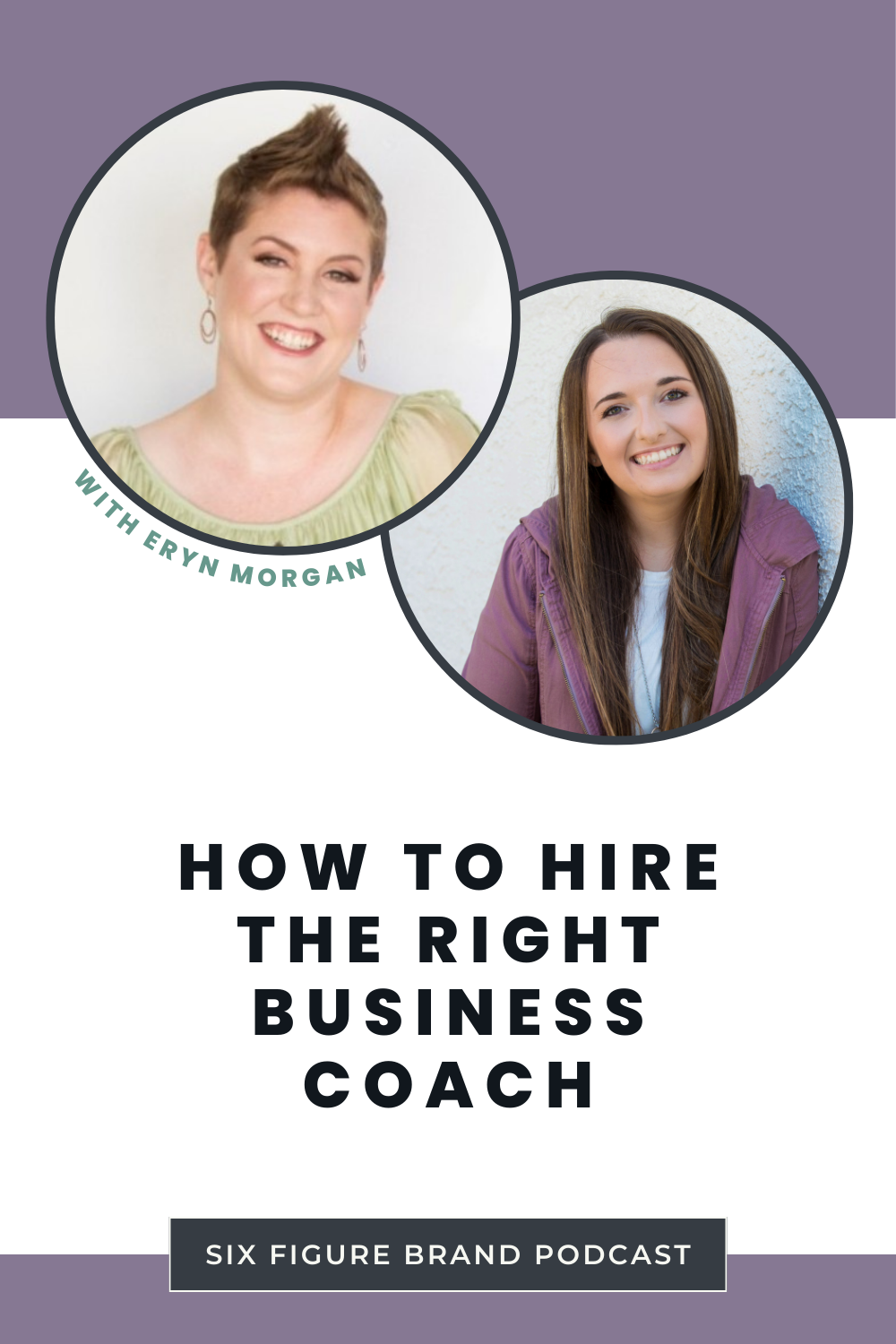
Ep. 39 How to Hire the Right Business Coach with Eryn Morgan
When I started my design business, I thought business coaching was kind of a scam.
Fast forward to today, and I can honestly say that hiring my coach, Eryn Morgan, changed the entire trajectory of my life and business. So much so that even my skeptical husband is now on board with business coaching. That's saying something.
Recently, I sat down with Eryn for what felt like the most full-circle moment of my career. She was my OG business coach who helped me go from side-hustling, struggling designer to running a real, sustainable design studio. Now she's also a good friend and a client of mine. We've seen each other through nearly a decade of life and business transitions, and I wanted to pull back the curtain on what working with a coach actually looks like—and how to know if you're hiring someone who will change your life or just take your money and run.
Or listen on your favorite platform: Spotify | Apple Podcasts | Amazon Music | YouTube
Back To The Beginning
Back in 2017, I was working a soul-sucking 9-to-5 job and side hustling as a designer in every spare moment—mornings, evenings, weekends, and during my car commute, which became my moving learning lab where I'd listen to podcasts and soak up everything I could about running a business.
Then something shifted. I made about $12,000 that year and thought, "Wait a second. I might actually have a business here."
I knew I needed help, but I thought I needed help with marketing. I posted in a Facebook group (remember when those were a thing?) asking for marketing help, and after talking to a few people who couldn't really help me, someone finally said, "Hey, I own a design business too. It sounds like you need a coach. Reach out to Eryn."
Our first conversation happened while I was driving home from work and Eryn was cooking dinner—we were in different time zones. And one of the first things we bonded over? Our mutual love of potatoes and all the delicious ways they can be prepared.
I interviewed another coach too, and when I came back to Eryn, I was honest: "You're more expensive, but your sales call was better." She took the time to listen to my story, to understand where I was, and to meet me where I was at. That vulnerability and trust mattered, and it's something she's never forgotten.
Is Business Coaching a Scam?
Here's the truth: there are a lot of coaches out there who shouldn't be coaching.
Eryn doesn't mince words about this. Over the last several years, trust in the coaching industry has eroded, and for good reason. Many people who wanted to be life coaches realized they couldn't show ROI for their clients, so they rebranded as "business coaches." The problem? They had no actual business experience beyond having a job.
Here's what Eryn believes at her core: you should have had at least some success in business and some level of business experience before calling yourself a business coach.
She doesn't have an MBA, but she has deep experience as a director of marketing, understands revenue generation, has taken meetings with high-level investors, and knows about angel investing and venture capital. These aren't things I needed her to know as a designer, but they broadened her expertise in a way that meant she actually knew what she was talking about.
How to Vet a Business Coach
When you're considering hiring a coach, ask these questions:
1. What kind of success have you had in your own business? Don't just accept vague answers. Ask for specifics: revenue generated, clients helped, measurable outcomes.
2. Do you have business experience beyond coaching? If they went straight from a job to coaching without ever building or running their own business, that's a red flag.
3. Do you understand my specific business model? A coach who's great at helping people sell group programs won't necessarily know how to help a project-based designer get consistent client work. A coach who specializes in e-commerce won't understand the unique challenges of a service-based business.
Eryn is crystal clear about this: she works specifically with website, brand, and graphic designers who have project-based business models. If someone with a product-based business came to her, she'd tell them no—because she can't guarantee results in an industry she doesn't deeply understand.
4. Can they show you results they've gotten for clients? Don't be afraid to ask for specifics. When I hired Eryn, I was paying her almost all of the money I was making at the time. I needed assurances it was a good investment. She told me straight up: "If in six months you're not making more money and this isn't profitable, stop working with me. You're not going to hurt my feelings."
That was enough for me to take the leap.
What a Coach Should Actually Do For You
If you ask me what Eryn did for me, my gut response is "literally everything." But let me break down the big ones:
1. Help You Build Trust in Yourself
This is the least sexy thing to put on a billboard, but it's the most important. Eryn teaches women how to make great decisions and trust their instincts.
To this day, I still hear her voice in my head telling me to trust myself. If I'm getting weird vibes on a discovery call and seeing red flags, I don't have to work with that person—it could turn into a nightmare project. If my instincts are telling me something's off, I'm probably right.
2. Create a Clear Path to Revenue
If you don't have money coming in, you don't have a business—you have an expensive hobby.
Your coach needs to help you:
Design crystal-clear offers that you know how to sell
Price them appropriately so you can confidently get on discovery calls
Understand exactly who you're selling to
Actually close projects and bring in revenue
If your coach can't help you see a very clear path to revenue, keep looking.
3. Teach You How to Sell (Without Feeling Slimy)
A lot of designers are introverted. We feel icky about sales. There's a whole conversation around "ethical selling," and here's Eryn's take on it:
If you make someone an offer, they say yes and pay you money, and then you do the things you said you were going to do and deliver the results you promised—you're being ethical. Period.
The only way you're not ethical is if you take their money and don't complete the project or stop returning their calls and emails. That's called being a sleazy slimebag, and that's not how we operate.
Eryn doesn't just tell you to "raise your prices." She starts with where you are right now: How do you feel about your current pricing? What would you like to change about the way you work? Then you can determine whether your pricing is a good match or needs tweaking.
4. Help You Show Up as the CEO of Your Business
Offers, sales, marketing, and how you show up as the CEO—these are the core things your coach needs to help you with. They might have different methods or signature processes, but those processes need to match your business model.
If you're a project-based designer and your coach's signature process is all about selling group programs or building an e-commerce empire, you're going to struggle to fit your business into their model.
My Journey With Eryn: The Highlights
Some of my favorite moments and lessons from working with Eryn:
Summer 2019: I had just gone full-time in my business, then got really busy, then started hating my life. I was having anxiety attacks every day and it would take me hours to psych myself up just to open my email.
Eryn didn't sugarcoat it: "This is what you've worked so hard for, and we are far past time to hire help. We need to do something now."
I was paralyzed by the idea. She swooped in: "Here's the person you need to hire. Here's what they need to do for you. Just go talk to them."
I'm still working with that person today. If she ever leaves, I'm just going to close my business.
The Pivot to Team: That moment of hiring my first team member was huge. It meant I was no longer just a freelancer or solopreneur—I was a business owner. Eryn helped me understand that you can't scale past a certain point if you're the only person doing the design work.
She also taught me something critical: there are only so many hours in a day, and you can only design for so many of those hours. At some point, you have to decide: Am I going to grow through team, or am I going to systematize and add tech until I can't automate anymore, accept that I'm capped, and be okay with that?
Both are valid choices, but you have to be intentional about which path you're taking.
When to Stop Working With a Coach
Here's something we don't talk about enough: you shouldn't work with a coach forever.
When Eryn and I stopped working together, I had so many feelings. I loved her, I loved working together, but I realized something: whenever I sat down with a problem, I already knew what she was going to say.
Some coaches will have you feeling like you can't survive without them. That's a red flag.
Eryn trains her clients to not need her anymore. And when the journey is done, she'll be the first person to tell you. She's had clients do a single 90-minute intensive with her, get everything they needed, and ride off into the sunset. She's also had clients work with her for four years and go from zero to multiple six figures.
The length of your journey will be unique to you, but when it's time to move on—whether that's because you've gotten everything you need or because the challenge you're facing isn't her sweet spot—she'll tell you. And she'll help you find the right person if that's what you need.
Eryn's Story: The Ups, Downs, and Coming Back
While I've been sharing what Eryn did for me, her own business journey hasn't been a straight line.
When COVID hit in 2020, Eryn had 36 one-on-one clients, and all of them had access to her via Voxer. She was carrying the fears, emotions, challenges, and pain of all of her people during that initial phase, and it broke her. She slowly, carefully ended contracts at term—not because her clients weren't amazing, but because she just didn't have it in her anymore.
To keep earning money (which wasn't optional), she took on what she calls "embedded projects"—five-figure monthly retainers working inside companies. They were train wrecks, and she really didn't like the work. But she learned an incredible amount about business operations, leadership, team management, and hiring.
During that time, she also got her Kolby certification, thinking she might serve clients as a Kolby-certified business consultant. But she was depressed, living in the woods of Pennsylvania, asking herself why it even mattered if she changed her sweatpants that day because nobody was going to see her anyway.
So she made a change. In 66 days, she sold two houses, moved a business, bought a house, and moved two golden retrievers from Pennsylvania to Florida.
Eryn’s Rebrand: A Full-Circle Moment
Once Eryn got to Florida and started figuring out who she really was and who she was meant to serve, she kept coming back to the same answer: project-based designers.
That's when I got an email from her. I had just had my daughter (or was about to—it's a blur), and Eryn said, "Hey, I need you to do a rebrand for me."
It was one of the coolest full-circle moments of my career. She had done so much to get me where I was, and now I got to use all those skills to help her show back up in the way she wanted to.
I was obviously the best person for the job—not just because I'm a good designer, but because I knew her so well and I knew exactly what we needed to communicate to her people.
The result? What Eryn calls her "forever brand." (And to be clear: that doesn't mean it's done. Branding is never done. It's constantly evolving, and we're still iterating and refining together.)
But it's a brand that feels like her, that resonates with her ideal clients, and that stands the test of time. The visuals do more than we even realized—there's an inclusivity baked into the brand that wasn't even intentional, but it's become one of Eryn's favorite parts of how she shows up.
Introducing Creative Autonomy: Eryn's New Group Coaching Program
After years of one-on-one coaching and then stepping back, Eryn kept having the same conversation: designers telling her there was no one in the space for them at their level.
So she's launching Creative Autonomy, a year-long mastermind and coaching program specifically for designers. It's hand-curated (you have to apply and she has to say yes), and it includes robust AI-powered onboarding that gets her up to speed on your business asynchronously, a personalized 28-day challenge in February tailored to your specific goals, and then a full year of mastermind calls, hot seat coaching, and office hours.
One of Eryn's superpowers is bringing people together. I went to one of her conferences back in 2018, terrified to go somewhere by myself, and somehow felt so comfortable and welcome. Then she put together a group coaching program, and I'm still in touch with almost all of those women on a monthly basis. That's the kind of connection she creates.
My Favorite Eryn-isms
If you take nothing else away from this post, take these three pieces of wisdom. They are truly the “Eryn-isms” that have stuck with me even years after working together, and that serve as a guiding light in the way I run my business to this day.
1. "When people pay, they pay attention."
Especially when I was very new, I thought if I just did work really cheap (or free), I'd get exposure and visibility and people would tell their friends about me.
That's not real. What will probably happen is they'll ghost you.
2. Look for past evidence of things working out.
When you're feeling like you have no idea what you're doing and things aren't going to work out, look back at times you've felt this way before—and remember how well it worked out.
I felt this way when I went full-time in my business, when I moved, when I had kids. Every time, I look back and think, "Okay, I felt this way then, and look how well it worked out." It's such a powerful mindset tool.
3. "People buy from people."
The world continues to change and evolve. AI is coming on the scene in ways that are making designers nervous about what they'll face in the coming months.
But here's what will always stand the test of time: people buy from people.
You're selling a website to a person, and that person has needs, challenges, wants, and desires. Your goal isn't just to produce a website—it's to help them transform through all the challenges they experience in the course of doing business.
Investing in relationships is never a bad investment.
The Bottom Line
Working with Eryn truly, truly changed the entire rest of my life.
If you're a designer or creative looking for consistency in your business without burning out, if you're craving support from someone who actually understands the unique challenges of running a project-based design business, I can't recommend Eryn enough.
And if you're considering hiring any coach (not just Eryn) remember:
Ask about their actual business experience and results
Make sure they understand your specific business model
Don't be afraid to ask hard questions
Trust your gut about whether it feels like a good fit
Know that you shouldn't need them forever
🔗 Links & Resources Mentioned In The Episode:
➡️ Eryn's Website
➡️ Connect with Eryn on LinkedIn
➡️ Learn About the Creative Autonomy Mastermind
➡️ Follow Morgan on Instagram @spechtand.co
🎧 Listen to episode 39 of The Six Figure Brand Podcast on Spotify, Apple Podcasts, Amazon Music, and YouTube
