
Ep. 45 Neurolinguistic Programming for Better Sales with Nikki Rausch
If you have a business, then you need to know how to sell. And that can be one of the clunkier, crunchier parts of business for a lot of us that we didn't really sign up for.
We have a skill that we want to share with the world, and selling never really was on our radar when we decided to start our business. But here's the reality: without sales, you don't have a business.
That's why I'm so excited to share my conversation with Nikki Rausch, CEO of Sales Maven. Nikki has the unique ability to transform the misunderstood process of selling. With 25 years of selling experience, entrepreneurs and small business owners now hire Nikki to show them how to sell successfully and authentically.
We're diving into sales, branding, NLP (neurolinguistic programming), Nikki's experience in business, and so much more. If you've been struggling with sales in your business or you just want sales to feel easier and better, then this post is for you.
Or listen on your favorite platform: Spotify | Apple Podcasts | Amazon Music | YouTube
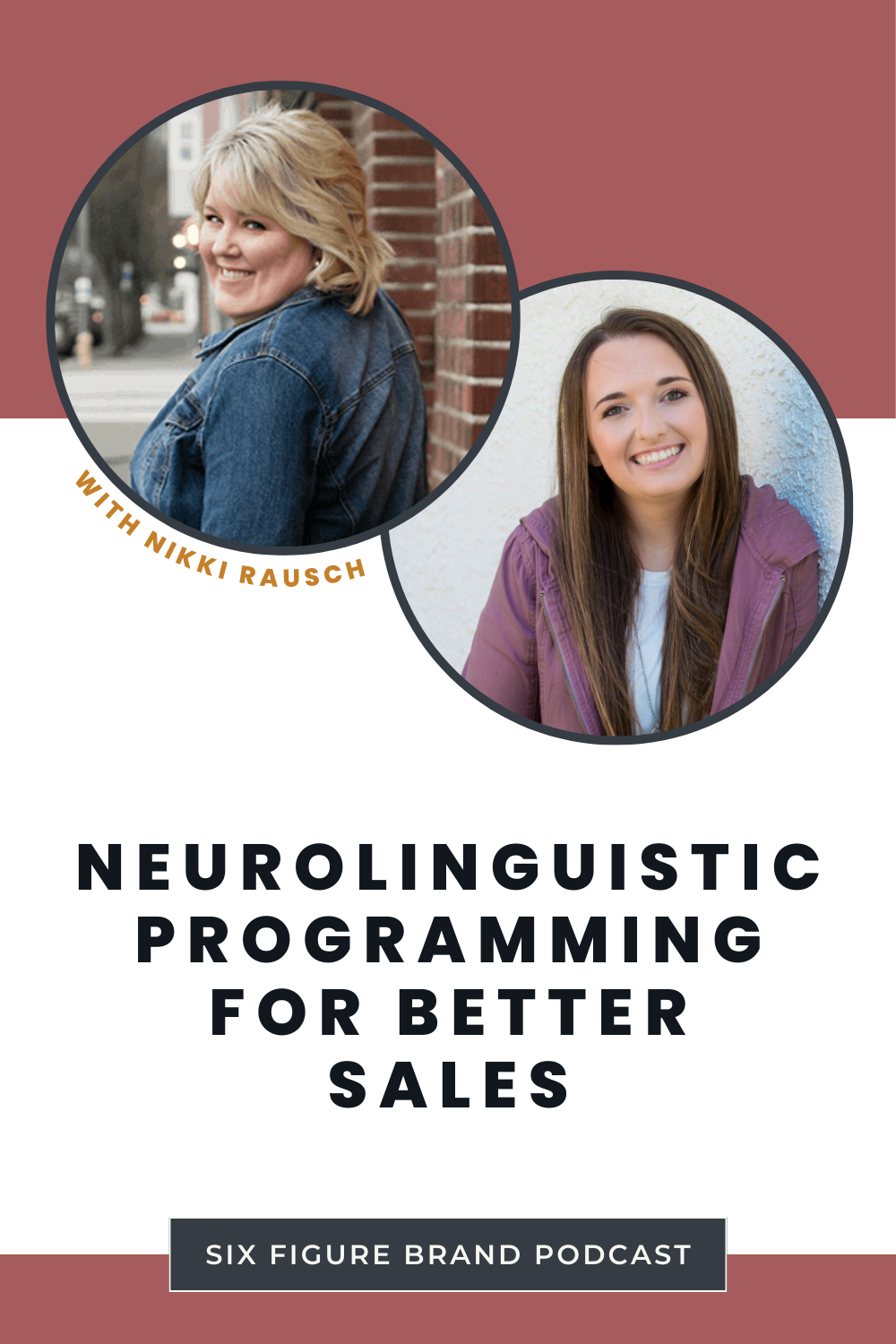
Meet Nikki Rausch
Nikki is a sales strategist and coach who helps people have better sales conversations whether you're selling through DMs, emailing with clients, or having live conversations. With over 25 years of sales experience and as a master certified practitioner of neurolinguistic programming (NLP), she combines psychology, communication, and sales strategy to help entrepreneurs sell without feeling gross.
From Corporate to Entrepreneurship
Nikki's journey into online business started when she hit a crossroads in her corporate sales career. At 40, she found herself wondering, "Is this it? Is there anything else out there for me?"
She ended up leaving her industry to work with her NLP teacher, and that's when she started hanging around entrepreneurs for the first time.
"They're so passionate and they want to make an impact in the world. And that just felt really attractive to me," Nikki shares. "You know, this whole concept of like, follow your passion and you'll never work a day in your life. Like I never got that. I didn't understand that. I was like, I must have no passion, not even an ounce of it in me."
But as she got to know these passionate entrepreneurs, she realized they were really struggling to make money with their passion. And it was because they didn't understand how to be effective in sales.
She started helping some of them on the side, not with the idea of having a business, but just wanting to spend time around super cool, passionate people. Then somebody pulled her aside and said, "Why are you not teaching this? Why are you not helping more people?"
Now, 12 years later, she's having the time of her life working with passionate entrepreneurs and teaching them how to be more effective in sales.
Why We Think Selling Is Gross (And Why It Doesn't Have to Be)
I talk a lot on this podcast about how we're never taught how to run a business. We get the degree, we get the corporate job, but nobody teaches us bookkeeping, how to incorporate as an LLC, and most importantly, how to make sales.
And here's the thing: you don't have a business if you don't make sales.
But so many of us have this mental block around selling. We think it has to feel gross, icky, or manipulative. So I asked Nikki: what would you say to somebody who says, "Well, I don't want to be salesy"?
Sales Is WITH Someone, Not TO Someone
"I understand because you've probably been on the receiving end of somebody who it has felt icky and gross to be in a conversation with," Nikki says. "What I teach is that sales isn't something that you're doing to another person. It's something you do with another person."
When you can start to shift your mind around this, you realize: this is me showing up and being of service to somebody. This is me not trying to convince anybody to buy from me. This is just asking questions and asking smart questions in a way that helps me identify: am I talking to an ideal client or am I talking to somebody who it's nice to have met them and I can bless and release and move on?
If you don't understand how to ask the right questions or what's going on in the conversation, you might just be gathering friends. Or you might just be talking to people who will never remember your name or think about you again because there's no strategy or structure to what you're doing.
The Best Sales Experience Ever
"Sales doesn't have to feel gross," Nikki emphasizes. "Many of my clients will come to me with this idea of like, oh, I've been so hesitant to want to learn how to sell because it does feel gross and manipulative. And then they will say something to me like, I just had somebody buy from me and they said to me that was the best sales experience I've ever had."
That's what happens when you learn to do it in a way that isn't manipulative or gross. It's about doing it with somebody. It's not about talking at somebody. It's talking with somebody and being of service and doing it in such a respectful way that the other person is like, "That's the best experience I've ever had."
The Three Things That Need to Be in Place Before a Sale Can Happen
Nikki teaches that there are really three things that need to be in place before the sale can happen:
1. Does this person even have a need for what you offer? You can't manufacture that need.
2. Do you have an offer or solution that's going to meet that need? Great, you've got those two things in place.
3. Do you have permission to put your offer in front of them? This is the kicker. This is the one that people often miss.
When those three things are in place, selling gets easier, not just for you, but for the buyer too. They're like, "This is the best sales experience I've ever had" because you're meeting a need, you have a solution, and you have permission to sell to them.
That's why we're all disgusted by those DMs and emails that just show up out of the blue. "Hey, Nikki, I looked at your YouTube channel. You really suck at YouTube. You should totally hire me."
As Nikki says, "Well, first of all, you just insulted me and I never even said I care about your opinion about my YouTube channel. So go kick rocks, no thanks."
What Is NLP and Why Should You Care?
One of Nikki's favorite tools is NLP, or Neurolinguistic Programming. I first heard of NLP probably four years ago when it got really popular and buzzwordy in the online coaching space. Everyone was getting NLP certified, but nobody could ever actually tell me what it was and why I should care about it.
So I asked Nikki to break it down for us.
The Basics of NLP
"It can be very buzzy," Nikki acknowledges. "And here's why: there is no governing body. So somebody can go through a two-hour training and say they've been certified in NLP, which is total baloney. You can read a book and say, oh, I've been NLP trained."
For context, Nikki has over 1,200 classroom hours just in NLP, plus all of her years of experience.
NLP stands for Neurolinguistic Programming:
Neuro is the way we process information in our brains
Linguistic is the language piece (how do you speak to others, how do they speak to you, what kind of internal dialogue do you have)
Programming is about habits and patterns
The most basic way to explain it: it's really the study of communication.
When you understand how somebody is showing up in a conversation and how they're communicating with you, then you can learn how to make some adjustments to make the conversation flow more smoothly, to be in conversation longer, and to feel good about the conversation.
Being Flexible in Communication
Nikki's all-time favorite quote sums it up perfectly: "Blessed are the flexible for they shall not be bent out of shape."
The more you understand how to communicate with somebody who has a different style than you, the more you're able to add flexibility to put the other person at ease so that the conversation flows more smoothly.
Think about it: you've probably met somebody and instantly felt a connection to them. Like, "I don't know where you've been all my life, but I just feel connected to you. We could talk for five hours and it'll feel like 10 minutes."
On the flip side, you've probably talked to someone for 10 minutes and felt like you need a nap. It's been like two hours, right?
One drives energy for you, the other drains energy. Learning how to adjust your style so that the other person feels energized and engaged in conversation with you is where NLP can really come into play.
How to Start Implementing NLP in Your Business
If you're brand new to this and don't have 1,200 hours of training, how can you start learning about NLP and implementing it into your business and sales conversations?
1. Pay Attention to the Words Your Clients Use
This seems obvious, but it's so critical. Sometimes we might describe something in a certain way, but if you actually ask your clients, they'll describe it completely differently.
If you want to speak to your ideal client, it needs to be in their words.
Nikki shares a great example: "I had a client who was a photographer and she was really struggling because she was always talking about her photographs. But when we started breaking down the clients she was talking to, I was like, well, how do they describe it? And she's like, they always call them pictures. I'm like, okay, so you should call them pictures. You should talk about the pictures they're going to get because that's speaking their language."
It's like if you travel overseas and say, "Well, I speak English. You all should speak English here because that's what I do." Other countries are going to look at you and say, "How about if you go home?" You don't get to show up and demand everyone be like you.
But if you can speak their language and use their phrases and words, you'll connect.
2. Use "You" Statements, Not "I" Statements
We often write from our perspective with lots of "I" statements: "This is what I think, this is what I know, this is what I want for you."
But that's not interesting to somebody who doesn't already know you and care about what you want and think.
Instead of writing "I" statements, make them "you" statements so that the reader feels like you're speaking to them.
Instead of saying, "I want this for you" (which you should never say to somebody you don't know), say:
"Would you be interested in this?"
"Would you find value in this?"
"Would this be helpful for you?"
That engages their brain. You're actually asking them a question instead of making a statement about yourself.
As Nikki points out, this is the equivalent of being the person who shows up in your DMs saying, "I looked at your YouTube channel and I don't think you're doing it very well and you should totally hire me."
It's not about your intention. It's about how your intention is received by the reader or buyer.
The Power Dynamic Issue
Using "I want this for you" creates an uncomfortable power dynamic where you're telling that person: I'm smarter than you, I know better than you, it's all about what I want.
As an audience member, if you came to me and said that, I would be like, "Well, who the heck are you to think that you get to have an opinion about what you want for me?"
In a sales conversation, there always needs to be a balance of power. If there's an imbalance, if you act like you hold all the power or you know everything, people will go away. They'll find somebody else they feel connected to.
We want to allow for them to feel that connection to us. So it isn't about what I want. It's about what's important to you as the buyer.
3. Match Rate of Speech in Live Conversations
In a live conversation (whether on the phone, Zoom, or in person), you can pay attention to someone's rate of speech.
Think of it on a spectrum from 0 to 10, with 10 being someone who talks really, really fast and doesn't even take a breath between sentences. On the other end, maybe they're at a 4 and they really take their time when speaking.
Whatever your rate of speech is, you're perfect. But remember: in order to be in conversation with somebody, you need to make it easier for them.
If you're a fast talker and you want to earn the business of somebody who has a slower rate of speech, you need to slow down. I'm not talking about mimicking them, just showing some flexibility in your behavior.
Nikki shares a personal example: "I tend to be a faster talker and I have somebody in my life who's very important. And this person has such a slow rate of speech that sometimes I think she's done with her sentence, but she's only halfway through. And when I'm not trying to be my best version, I will step on her thoughts. I will interrupt her when she's still speaking. That's so rude."
Be willing to adjust. If you're at an 8 and they're at a 4, if you could slow down to a 6, it's going to be more comfortable for them to be in conversation. You won't interrupt them, you won't step on their thoughts, and you won't talk so fast that they can't even process what you're saying.
And here's the brilliant thing: when you start making adjustments, oftentimes they'll adjust as well. You'll find a happy medium and it'll make the conversation easier for both of you. But you have to initiate it first.
Why This Matters for Your Business
I'll be the first to say that vibes matter when it comes to who you hire in your business. If I feel like every time we get on a call I'm going to be exhausted by you, I'm not going to hire you. Business is already hard and tiring enough. I don't need more of that in my life.
Vice versa, I've been on calls where somebody's like a 1 or a 2 and I'm falling asleep over here, thinking, "Okay, come on, get to the point. Let's go."
Your buyers are making decisions about you in that same way. If you're willing to make some adjustments, you'll earn more people's business. They'll feel better about their investment in you. They're going to hire the person who makes them feel like, "I just feel like she gets me. I just feel like she's easier. She's listening to me."
That's what we're going for.
The Connection to Branding
Here's where everything comes together: you are not the only person that offers your service on the internet. Frankly, you're probably not even the best. There's probably somebody out there who can do it better than you.
But your client is going to hire you because they resonate with you specifically. Your personality, the way that you talk, your common interests, your shared values, all of that.
And your branding (the way that your business looks online and the way that you show up) is how you convey that to people.
Using Client Language in Your Brand Research
When I'm doing brand research, I will tell clients: if you have any intake forms, feedback, or anything that your clients have written down about how they felt before they hired you, how they felt after, what the experience was like, I want to see that.
But even better would be if you record sales calls or coaching calls. And I can actually watch and hear them talk to you and about you.
That is a gold mine.
People get uncomfortable asking to record calls, but here's the thing: people don't care. And when I tell you that's a gold mine, I'm not kidding.
How to Get Better Client Feedback
It comes down to asking better questions. If you just say, "Tell me what you think about working with me," that's so open-ended they don't know where to go with that.
The worst kind of testimonials are: "Nikki is really great. I recommend her." Okay, I appreciate it, but that said nothing.
Ask more specific questions:
"What was the thing you were really struggling with before we started to work together?"
"What was the thing that felt like a huge shift for you?"
"What specifically..." (Nikki loves the word "specifically")
That word helps narrow their focus and now you can actually gather good information.
Don't Be Afraid to Ask Permission
"Would it be okay if I record this session today? And here's how I might use this information."
That's different than saying, "I'm going to record this and here's how I'm going to use it."
When you ask permission, it shows respect. They feel good about it and they're probably going to be more inclined to want to be helpful to you.
It's totally fine to ask questions like, "Is there ever an opportunity that we might work together or that you would find value in getting some sales coaching?"
You might get a "no thanks," but you're probably not going to be offended that someone asked. You'll just give an answer. It will be easy to give an answer to a simple question.
Don't be afraid to ask.
A Real Transformation Story
Nikki shared a recent client success story that perfectly illustrates the power of these small shifts.
She worked with a client who was going to be delivering a proposal for a scope of work. When Nikki reviewed the proposal, she made several NLP-based adjustments:
1. Top-down selling: She recommended listing the most expensive thing first instead of starting with the cheapest option. When you go bottom-up, you're essentially telling someone they have to pay more to get more. But with top-down, they realize they have to give things up in order to save. It's a very different mindset.
2. Standing in authority: The client felt hesitant because it was a big dollar amount to propose. She was going to commit them for a certain period, but Nikki encouraged her to think about where they're really going to get the transformation. They'd get it by committing to a minimum number of months. So Nikki asked her to double it.
3. Language shifts: Getting rid of "can" and "will" language. Instead of "this can do that," it's "we do this" and "this is the deliverables." Speak in present tense, not wishy-washy language.
The result? The client selected the most expensive option and it resulted in another $13,500 in business just by making these tiny little shifts to the way it was proposed and laid out.
Now the service provider gets to deliver on something she's really excited about, and the clients are really excited because they're going to see phenomenal results from this commitment.
Two Key Takeaways
There are two critical things I want to call out from that story:
1. You don't need to add more to charge more. So many of us think if we want to make more money or sell our bigger package, we need to always be adding more value, which really translates into creating more work for ourselves. But you don't need to be changing your offers and packing them with more deliverables. You just need to change the way you're framing them.
2. Use direct, confident language. Somebody is coming to you because they're unsure of what to do. They're lacking confidence. So you need to be sure of what to do and exude that confidence for them to feed off of. If you're saying "oh, well, it might do this or it could, or it can, or maybe," they're going to think, "Well, she doesn't seem like she's very sure. So why should I be sure enough to give her $10,000 of my dollars?"
Everything Is Connected
It always blows my mind how much of this sales and NLP stuff is right in line with all the branding work that I do.
All of this is so interconnected that it's really hard to talk about one without also talking about the other. When your branding is strong and your sales skills are solid, you create this whole ecosystem where:
Your visual brand attracts the right people
Your messaging speaks directly to them in their language
Your sales conversations feel natural and authentic
Your clients feel confident in their investment
They get amazing results and refer everyone they know
That's when you build a truly sustainable, profitable business.
🔗 Links & Resources Mentioned In The Episode:
➡️ Follow Nikki on Instagram @your_sales_maven
➡️ Grab Nikki's Free Gift Seal The Deal: Questions That Close Sales
➡️ Visit Nikki's Website
➡️ Follow Morgan on Instagram @spechtand.co
➡️ Grab The Stand Out Brand Foundations Workbook
➡️ Book Your Stand Out Brand Strategy Session (use code SFBPOD for $100 off)
➡️ Book A Brand Chat
🎧 Listen to episode 45 of The Six Figure Brand Podcast on Spotify, Apple Podcasts, Amazon Music, and YouTube
