
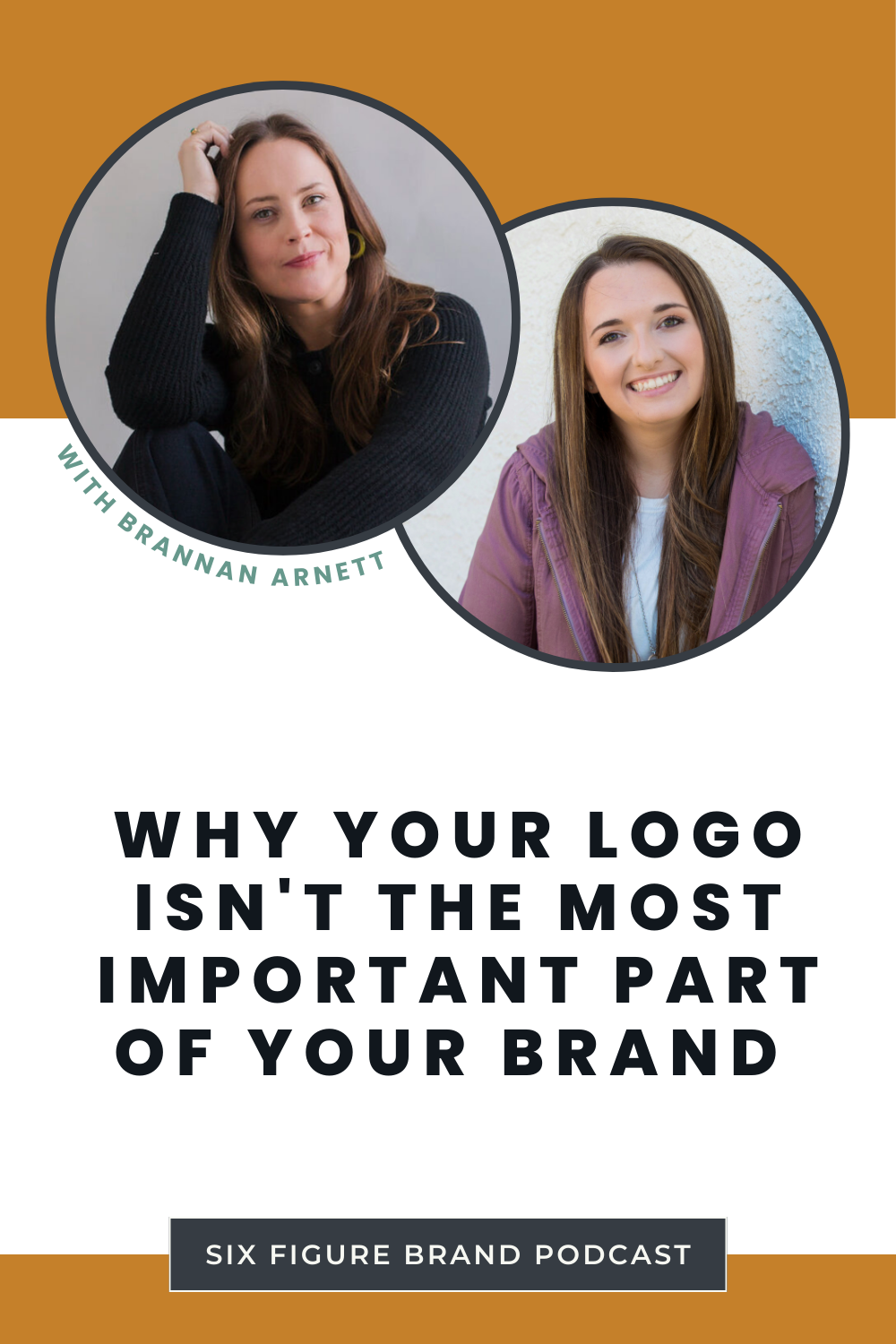
Ep. 57 Why Your Logo Isn't the Most Important Part of Your Brand w/ Brannan Arnett
If you're a service provider investing in your brand, you've probably put a lot of thought into your logo. Maybe you've even rebranded multiple times, chasing that "perfect" visual identity that will finally make your business take off.
But here's an unpopular opinion that's gaining traction among experienced brand designers: your visual identity isn't the most important part of your brand.
I recently sat down with fellow brand designer Brannan Arnett of Hone Creative Studio to discuss this controversial topic. We connected over a viral thread where Brannan boldly stated, "I've been designing brands for five plus years, and I have to say that I do not think your visual identity is the most important piece of your brand."
This conversation explores what truly matters in building a successful brand, why strategy trumps pretty logos, and how to know when you're actually ready to invest in professional branding.
Or listen on your favorite platform: Spotify | Apple Podcasts | Amazon Music | YouTube
From Classroom to Creative Studio: Brannan's Unique Journey
Brannan Arnett has been running Hone Creative Studio for over five years (formerly Golden Hour Designs until a 2023 rebrand). But her path to brand design is anything but typical.
For a decade, Brannan worked as a preschool and kindergarten teacher with a master's degree in early childhood education. She then transitioned to a part-time role as brand manager and eventually director of brand development for a nationwide franchise serving children and families—a creative arts learning center.
The Surprising Connection Between Teaching and Brand Strategy
"People always ask, 'How are you going to connect teaching preschool to brand strategy and brand design?'" Brannan explains. "And I promise it makes so much sense when you think about it."
The connection? Trust-building.
"Children will not learn from you if they do not trust you, if they do not feel respected by you, if they do not feel seen and considered by you," Brannan notes. "The same things we utilize to build trust with young children are a lot of the same things we utilize to build trust brand to brand and consumer to consumer."
There's another crucial skill Brannan developed in the classroom: communicating complex concepts concisely to people who don't understand the subject matter.
"You learn so much about how to communicate to somebody that does not understand what you're saying at all," I added. "Clients come to us because they have no idea about branding or what their brand should look like. That's an objection I deal with a lot—people say, 'I can't hire you because I don't know what I want.' And I'm like, 'Well, you're not supposed to know what you want. That's why you hire me.'"
The Pivot Point: Seven Months Pregnant and Ready for Change
When Brannan was seven months pregnant with her daughter, she reached a breaking point with her corporate role. Despite loving the work and maintaining a good relationship with the founder, there was growing tension around values misalignment and the company's strategic direction.
"I woke up one day when I was seven months pregnant and was like, 'I want to do my own thing. I'm ready to go out on my own. I have such a clear vision for what I want to do,'" Brannan recalls.
She spent the next two and a half to three years being all-in on her business, progressively stepping more into the strategy piece of branding as the foundation of everything she does.
When Your Former Employer Becomes Your Best Client
Here's something we don't talk about enough in the online business world: leaving your 9-to-5 doesn't mean burning bridges.
Brannan's former employer? Still a client.
"For a long time, my last nine-to-five that I worked was also a freelance client of mine after I had left," I shared. "I think in the online business world, a lot of us want to walk out of the building in a blaze of fire and burn the bridge and never talk to people again. And it doesn't have to be that way."
This transition approach offers several benefits:
Financial stability: Maintaining income during the transition reduces pressure and allows for more strategic business decisions.
Portfolio building: Continuing work with a known client provides case studies and testimonials.
Relationship preservation: Professional networks remain intact for future referrals and opportunities.
Testing ground: Working as a contractor allows you to test your business model with reduced risk.
The key insight? Just because a role isn't a good fit in a full-time employment capacity doesn't mean there's no room for collaboration.
The Three C's of Branding: Lessons from the Classroom
Brannan's teaching background directly informs her brand strategy approach, particularly what she calls "the three C's of branding": communicating concisely, cohesively, and consistently.
"To me, those are like the foundation," Brannan explains. "I talked about that a lot in my early years because that made so much sense to my brain, especially working with earlier stage entrepreneurs who didn't know what they wanted, didn't know what they should want, and didn't even really know where to begin."
The Client's Role vs. The Designer's Role
This is where the analogy of other professional services becomes helpful.
"When you go to the chiropractor, you don't say 'this vertebrae is popped out of place and my hips are misaligned,'" I explained. "You say 'my back hurts' or 'my hips hurt' and they figure out what's wrong and work with you on how to fix it. Similarly, it is our job to figure out—okay, here are maybe some of the pain points you're experiencing. Here's what your goal is. Here's who your audience is. And we tell them what their brand should be to achieve all of those things."
Brannan agreed: "You're supposed to come to me and just dump everything on the table and I'm going to help you sort through what makes sense and what goes well together and what creates that sense of cohesion and what we're just going to kind of toss off to the side and not use."
When Burnout Forced a Shift to Strategy-First
For both of us, the pivot to prioritizing strategy came after experiencing similar patterns with clients.
My Breaking Point
"I had three projects in the span of maybe six or eight months that just went really sideways," I shared. "The common thread between them was that they didn't have any sort of brand strategy. They were just 'here's what I want it to look like.' And I was trying to make that and then they either didn't like it or there were probably other things going on internally with their companies that I was not privy to."
"I had just had my second baby and I was like, 'I don't have time for this anymore. You're not having a good time, I'm not having a good time, it's stressful. I'm taking time away from my kids to work on this project that is not going to actually help you grow your business. We have to do strategy first.'"
The Evolution of My Process
My approach evolved through several stages:
Phase 1: Offering strategy as an optional add-on
Result: Clients consistently chose to skip it
Problem: Projects went sideways without strategic foundation
Phase 2: Making strategy a mandatory session at the start of every project
Result: Better projects, but still some misalignment
Problem: Sometimes clients didn't need the design package they'd purchased
Phase 3: Strategy sessions as standalone services
Result: Can recommend appropriate next steps after understanding the full picture
Benefit: Can identify when clients don't need design at all, or need different services
"I had a couple of clients who after their strategy session, I realized, 'the design package they bought from me is not actually what they need' or 'they're not actually an ideal client,'" I explained. "If I had just done the strategy session, I would have known that and been able to guide them better."
The Client Response
Despite initial concerns about the investment, the feedback has been overwhelmingly positive.
"Every single person is like, 'That was the most productive 90 minutes I've spent on my business in a long time,'" I noted.
The Unpopular Opinion: Your Visual Identity Isn't Everything
This brings us to Brannan's viral thread and the core of our conversation.
The Full Context
"To be very clear, I have offered strategy the entire time I've been in business," Brannan clarified. "At different times I've played with making it a non-negotiable of the packages and the work that we do. And inevitably as business ebbs and flows, motherhood takes over my summers and I like to take some time off around the holidays, I'll take on some projects that are just purely visual identity because the client's a good fit, I'm excited about the business, their budget's not there."
She continued: "I also want to say that I think there's a lot of checkmarks that people need to hit before they're really ready to invest in the level of strategy that I want to do and that we offer. Sometimes it's just not a good fit. Sometimes you're just not there."
When Visual Identity Alone Can Work
Brannan shared a powerful example: "I'm thinking of one particular client who we moved through a mini package of strategy and I audited her visual identity because her budget just wasn't there. And she just absolutely took off online and her social content grew her page tremendously. A lot of her work is bookings virtually and she just didn't need a website. She didn't need a rebrand."
The key insight? "Your visual identity actually isn't the most important thing right now. Your voice, your offerings, the way your content resonates—those drove her success."
The Challenge of Selling Strategy
Both of us acknowledged the difficulty in educating clients about strategy's value.
"I agree. I also have found that to be a challenge to sell the strategy piece, especially when it's on the table to not do it," Brannan admitted.
"It's interesting because people both can say, 'I don't know how to sell my services and I don't know how to concisely share messaging,' and then they can also say that they'll be fine without the strategy piece, which solves those problems."
The Sticking Point for Clients
"The sticking point for me is I think that clients get hung up on, 'Well, why would I pay you for a strategy session when I could just go to another designer and pay them and just get my brand faster?'" I explained.
It's like saying, "My back hurts and this person is going to fix my back," versus "Let's do a full body scan and see if there's anything contributing to your back hurting."
The reality: Clients who understand strategy value it immensely. Those who don't will continue chasing quick fixes with disappointing results.
What Actually Matters More Than Your Logo
So if visual identity isn't the most important element, what is?
My Top Three Priorities
1. Your Ideal Client
"Everything you're doing is for them," I emphasized. "If you don't know who that is, you are really just throwing spaghetti at the wall and hoping that it works, and probably it won't—or it will be like a lot more work than it needs to be."
2. Your Brand Values
"I think that is the thing that makes your brand human and helps people connect with you and really is probably the biggest driver of how your visuals look," I explained.
"For example, if you value making people feel grounded and they trust you, then you're going to use very different colors than if your values are being high energy and motivating people or something."
3. Your Client Experience
"You can do everything right, and if you drop the ball actually working with your clients, none of it matters."
Brannan's Comprehensive View
Brannan took a more holistic approach:
"I think a lot of things matter. And it's not even just individual elements—it's the collection of these things working together that matters, and the consistency of them working together and the cohesion of them working together."
Her key elements include:
Positioning and language: "The words you use, how you communicate with your audience, the tone of voice—using that as an example, the consistency of that over time builds trust or doesn't."
Visual consistency: "Color psychology and the font pairings and the way that those things work together or don't."
The ideal client foundation: "Obviously your ideal client is the underlay of all of that. That's what that's all based on."
The client experience: "You could deliver such a premium client experience and have the world's most terrible logo or just basic, meaningless, not memorable at all logo, and you could still find great success in business. The way that you carry people through that experience is probably the most important piece."
Brand values as your North Star: "Values are huge. To me, values are like your North Star. They're the thing that dictates so many of these other things."
Energy and authenticity: "The energy that comes from a brand, especially a small team or a single founder brand—if you don't buy what you're selling, why would I buy what you're selling?"
The Power of "Why"
"One of the most powerful questions—I'm sure this is a pretty universal experience in the strategy world—is just 'why,'" Brannan noted.
"'I want my colors to be neon pink and neon green.' I'm not going to tell you that's wrong, but tell me why. Because if we can't tie it back to something meaningful and needle-moving, why would we do it?"
The Three Visual Elements That Actually Matter
While we agree visual identity isn't the most important overall, certain visual elements do carry more weight than others.
The Surprising Truth About Logos
"Your logo doesn't even get used that much," I pointed out. "I just recently revamped my Specht Co logo and I like it fine, but I didn't fall to my knees and be like, 'Oh my God, this is the most beautiful logo I've ever designed.' I literally was like, 'Okay, this'll work. Cool, done.'"
"It lives in the header of my website and then on contracts I send out and some documents and stuff, but it's not anywhere on my social media."
Brannan agreed: "You're probably pretty rarely going to see my logo. I don't even really like my logo. I myself put too much pressure on my logo, and so it's like, okay, let's just take a break from tweaking it, because ultimately it's not the thing that people are connecting with."
What We Actually Prioritize
Brannan's top three (in order):
Colors
Fonts
Imagery (brand photography, videography, B-roll footage)
My top three (prioritized slightly differently):
Colors
Fonts (tied with imagery)
Imagery
Why Colors Come First
"Your brain recognizes color faster than it recognizes anything else," I explained. "I could show somebody Home Depot orange and Tiffany blue and they would know exactly what businesses those are from based on just the color. That's the number one way that people can be consistent and recognizable."
"There's so much emotion tied up in colors that we just don't talk enough about," Brannan added. "I personally really resonate with the idea of I feel things really deeply and I think a lot. So colors mean a lot to me. You can just tell when a color palette feels disjointed and when it feels like you just kind of made it up."
The Role of Typography
"Fonts help you be recognizable but more importantly it's a readability and keeping things simple and consistent thing," I noted. "I hate it when I go on somebody's Instagram grid and every post has a different font. What are you doing? Just pick one. It doesn't even matter which one. Just choose one."
Brannan shared a common audit recommendation: "Get a thicker body copy font. That's going to do a lot for your website. Just that. And do less fonts."
Photography as Personality
"Photography is just one of the best ways to bring your personality to life," I explained. "I get that that's not realistic for most of us, probably. But in a perfect world, that's what I would say."
We both acknowledged this requires significant investment—comprehensive branding with professional copywriting and photography can easily exceed $15,000.
When You're Not Ready to Invest in Professional Branding
This is crucial: not everyone needs professional branding yet.
The Six-Week Rule
"I tell people frequently—less often the further I get in business, but I do still once in a while get inquiries from people that are like, 'I started my business six weeks ago,' or 'I'm thinking about starting a business,'" I shared.
"I tell them all the time, 'Don't hire me yet.' Yes, you can hire me and you can pay me three to $6,000 for a brand and it will be a gorgeous brand. But what happens every time is that first six months to two years in business, you're doing so much figuring out—who do you want to work with? What services do you want to offer? Who is your audience?—that you're going to have to come back and redo that work anyway."
The Common Evolution Pattern
"I have seen so many times—frequently they start as a VA and then they realize, 'I really love doing ads' or 'I really love copywriting' or 'I really love this or that specialty' and they want to go down that road further. If they had invested a bunch of money in a general VA brand, they would have had to throw it all out."
The DIY Interim Solution
My recommendation for early-stage entrepreneurs:
"Just DIY something that is good enough. I think especially in the online world, all we have is our website and our social media, right? So we get really precious about it. We think that it has to be perfect. And I really want to encourage people that it shouldn't look like a first grader did it, but also good enough is good enough to get started."
The practical approach: "Choose some fonts, choose some colors, make a text-based logo, call it good and come back to me in a year and a half."
Understanding "Good Enough"
"Good enough is good enough to get started" doesn't mean sloppy or unprofessional. It means:
Clean, simple design that's functional
Consistent use of chosen elements
Focus on showing up and serving clients
Room to evolve as your business clarifies
Common Designer Mistakes That Actually Hurt Clients
The $2,000 Problem
We discussed the scenario of a struggling business owner coming to a designer with their last $2,000, desperate for a rebrand to "save" their business.
"Probably I'll tell you no at this point in my business," I admitted. "That is not the energy you want to be bringing to the table because you're going to be second-guessing yourself, you're going to be second-guessing me. You're putting so much pressure on your brand to do way more than frankly it's really capable of."
The better approach: Come from a place of abundance rather than desperation. "Things are going really well with what I already have and I'm ready to step into that next version of my business and I want to work on my brand. It's night and day difference."
What to Do Instead
Brannan's recommendation: "Maybe my answer is strategy. At minimum, some sort of audit to more deeply understand where the wheels are falling off."
Her suggested diagnostic approach:
Where is there a gap in the marketing process?
Do your offers make sense?
Can you sell your offers?
Can you talk about the outcome of your offers?
Does your website guide people effectively?
Where in the customer journey are you losing people?
"I struggled to sell my services when there wasn't strategy attached to it because I don't believe in the value of this work," Brannan confessed. "I don't find this to be the best use of your resources."
The Nuance of Rebranding Energy
There is an important caveat to the "abundance vs. desperation" principle.
"I do think that in some cases, rebranding can really inject some new life and some new energy into your business," I acknowledged. "This happens to me all the time—clients are like, 'I need a new brand or a new website because every time someone asks for my website, I cringe or I don't want to pitch myself for things because my brand looks like crap.'"
"Then we do their rebrand and they book all these new clients or they get invited for a speaking engagement—not really because their brand looks better, but because they're showing up so much more confidently."
The Amplification Principle
Key insight: Branding amplifies whatever is already happening in your business, whether good or bad.
"If there are big problems in your business—you're not getting any clients or you have money management issues or whatever—branding is not going to solve that," I emphasized.
Practical First Steps Before Rebranding
Before investing in professional branding, try:
Talk to your existing clients: "Do you have any clients that have been good experiences that you can go back and say, 'First and foremost, do you have any friends like you that need my service? But also, what drove you to work with me?' Get some of that feedback and start working that into your marketing."
Conduct an audit: Identify where the breakdown is happening in your customer journey.
Clarify your offers: Make sure what you're selling actually solves a problem people will pay for.
Test your messaging: See if incorporating client feedback improves your conversion rate.
The Designer's Responsibility
"One of my biggest pet peeves is that frequently I feel like I'm having to rehabilitate our entire career field when I'm on a discovery call," I shared. "People are like, 'I paid a designer and they ghosted me,' or various things that have gone wrong."
The most common complaint? Designers don't teach clients how to actually use their brand.
"They say, 'Here's your logo, here's your color palette, here's your fonts, whatever, and a style guide' and send them on their way. But these people are not designers. They don't know how to use a style guide."
My approach: "I go through a lot of steps and extra effort to help educate them around that and make sure that they feel good actually building upon what we have created for them."
The Trend Problem
Brannan identified another major issue: designers creating trendy brands that won't stand the test of time.
"The thing that irks me the most is this feeling of 'this doesn't feel unique. This doesn't stand out. This feels like so-and-so's brand or I've seen something like this,'" she explained.
"I feel like purple and red are having a moment right now together. And I love it. I got a clutch. It's purple and red. That's where I'm having fun with trends, not in my visual brand."
The problem with trendy brands: "It just feels like you're doing a disservice to your client. Your client's obviously looking to make some sort of sustainable investment in their visual identity."
The Copycat Syndrome
"My hypothesis is that people see some big creator or business owner's brand and they're like, 'I want that because if I look like them, then I will be successful,'" I noted. "It's kind of like the business version of when we're in middle school and we're like, 'I need to dye my hair or wear these clothes and then I'll be cool.' It doesn't work that way. You blend in for sure."
Niche Style vs. Adaptable Approach
We discussed two different approaches to positioning as a designer:
The specialist approach: Having a very defined style (like a tattoo artist). Clients come to you specifically for that aesthetic.
The adaptable approach: Designing what's best suited for each individual client's needs, audience, and industry.
"I've had many clients say that they specifically have hired me because I don't have a super defined style," I shared. "All the brands I design look very, very different from each other. And I think that that's a strength of mine."
I admitted experiencing imposter syndrome about this: "I'm like, 'Well, these other people are the designer for whimsical brands or illustrated brands or whatever. And I don't have that. So it must mean that I'm not as much of an artist or something.'"
"But now I realize that that's a strength because not every single brand I put out there is going to look the same."
Brannan agreed with the value of this approach: "I think there's a lot of different ways to niche as a designer, but I do think it gives a different layer of credibility to your approach of, 'I'm going to design the brand that's best suited for you, for your stage of business, for your target audience, your values, et cetera, and your services and your industry.'"
The risk with niche styling: "If you have a really niche style, you're expecting and you kind of need people to know when they come to you that that's the kind of brand that they're looking to emulate. And you probably wouldn't find that out until you're deep in the strategy process that your style is actually not the style that they need."
The Personal Development Journey of Business Ownership
As we wrapped up our conversation, Brannan offered a profound observation:
"Being in business and working for yourself is this never-ending personal development journey. You're meeting yourself again and again and again, and if you're not able to get out of your own way and see things in a really objective business sense, you're really not going to grow."
She connected this to our earlier discussion about struggling business owners: "You reference the designer that might take the money and it's like, yeah, because they might also be in that position of 'I need to pay my rent this month.' Everybody just kind of finds themselves in the audience and in this segment of wherever they are in business. And ideally each hire helps you grow—maybe sometimes it helps you figure out what you don't need."
Key Takeaways: What Actually Builds a Strong Brand
1. Strategy Must Come Before Design
Don't make the mistake of jumping straight to visual identity. Without strategic foundation:
You'll likely rebrand multiple times without solving core issues
Your visuals won't connect with your ideal clients
You're putting a band-aid on deeper business problems
2. Your Ideal Client is the Foundation
Everything in your brand should be built around serving your ideal client. Without knowing who they are:
You're throwing spaghetti at the wall
Your messaging won't resonate
Your visuals won't attract the right people
Your business will require more effort for less return
3. The Most Important Visual Elements Are Colors, Fonts, and Imagery
Your logo matters less than you think. Focus on:
Colors: Your brain processes these fastest; they drive recognition and emotion
Fonts: Create consistency and readability across all touchpoints
Imagery: Brings personality to life and humanizes your brand
4. Energy Matters More Than Perfection
"If you don't buy what you're selling, why would I buy what you're selling?"
Brand from a place of abundance and confidence, not desperation. The energy you bring to your business—and your brand—directly impacts how people perceive and connect with you.
5. Consistency and Cohesion Trump Individual Elements
It's not about having the perfect logo or the trendiest colors. It's about:
All elements working together harmoniously
Showing up consistently over time
Building trust through reliable, cohesive presence
Aligning every touchpoint with your strategy
6. DIY is Better Than Premature Professional Branding
If you're in your first six months to two years of business:
You're still figuring out your offers, ideal clients, and positioning
A professional rebrand is likely premature
Create something "good enough" and invest in strategy later
Come back for professional branding when you have clarity
7. Client Experience Can Overcome Visual Mediocrity
"You could deliver such a premium client experience and have the world's most terrible logo and you could still find great success in business."
Don't neglect the experience you provide while obsessing over your visual identity.
8. Ask "Why" About Every Brand Decision
Before committing to any visual element, color, font, or design direction, ask why:
Why this color palette?
Why this style?
Why does this serve my ideal client?
Why will this move the needle in my business?
If you can't tie it back to something meaningful and strategic, reconsider the choice.
9. Avoid Trendy Branding
Trends are for social content, not your core visual identity. Creating a trendy brand:
Dates quickly
Lacks uniqueness
Doesn't serve your specific audience
Represents wasted investment
10. Professional Designers Should Educate, Not Just Deliver
When hiring a designer, make sure they:
Include strategy in their process
Teach you how to use your brand assets
Provide clear guidelines and systems
Support you beyond file delivery
Questions to Ask Potential Brand Designers
Based on our conversation, here are essential questions to ask before hiring a brand designer:
"Is strategy included in your process, and is it mandatory?"
Red flag: Strategy is optional or not mentioned
Green flag: Strategy is integrated and non-negotiable
"Will this be designed in your signature style or customized for my specific needs?"
Understand whether you're hiring an artist or a strategic designer
"How will you help me understand and implement my brand after delivery?"
Look for education, training, and ongoing support
"What happens if my business evolves or I realize I need something different?"
Understand their revision process and flexibility
"Can you share examples of brands you've designed in my industry or for my target audience?"
Assess their ability to design for your specific context
"Do you offer audits or strategy sessions separate from full branding?"
This shows they prioritize finding the right solution over making a sale
It All Comes Back to Your Ideal Client
As we concluded our conversation, we returned to where we started: everything in your brand should serve your ideal client.
"Just to tie a bow on this conversation, we started out talking about what's the most important part of your brand, and we both agree that it's your ideal client," I summarized. "That's really what it's all about."
For those coming from creative or artistic backgrounds, Brannan noted: "It's kind of hard to separate the two, I feel like."
This is perhaps the hardest lesson for creative entrepreneurs: your brand isn't about you—it's about serving your clients.
The most successful brands aren't the ones with the prettiest logos or the trendiest color palettes. They're the ones built on strategic foundations that deeply understand and serve their ideal clients through consistent, cohesive, authentic presence.
Your visual identity matters. But it's not where you should start, and it's definitely not where you should end.
🔗 Links & Resources Mentioned In The Episode:
➡️ Visit Brannan's Website
➡️ Follow Brannan on Instagram @honecreativestudio
➡️ Follow me on Instagram @spechtand.co
➡️ Book Your Stand Out Brand Strategy Session (use code SFBPOD for $100 off)
➡️ Book A Brand Chat
➡️ Book Your Stand Out Brand Strategy Session (use code SFBPOD for $100 off)
🎧 Listen to episode 57 of The Six Figure Brand Podcast on Spotify, Apple Podcasts, Amazon Music, and YouTube
