
Ep. 64 Going Viral Isn't the Goal: Sustainable Social Media Strategy w/ Caitlin Wuethrich
If social media feels like a necessary evil to running your online business, a full-time job that never quite seems to pay off, you are not alone. Most of the service providers I talk to feel exactly that way at some point. And the reason, more often than not, isn't the algorithm. It's the strategy.
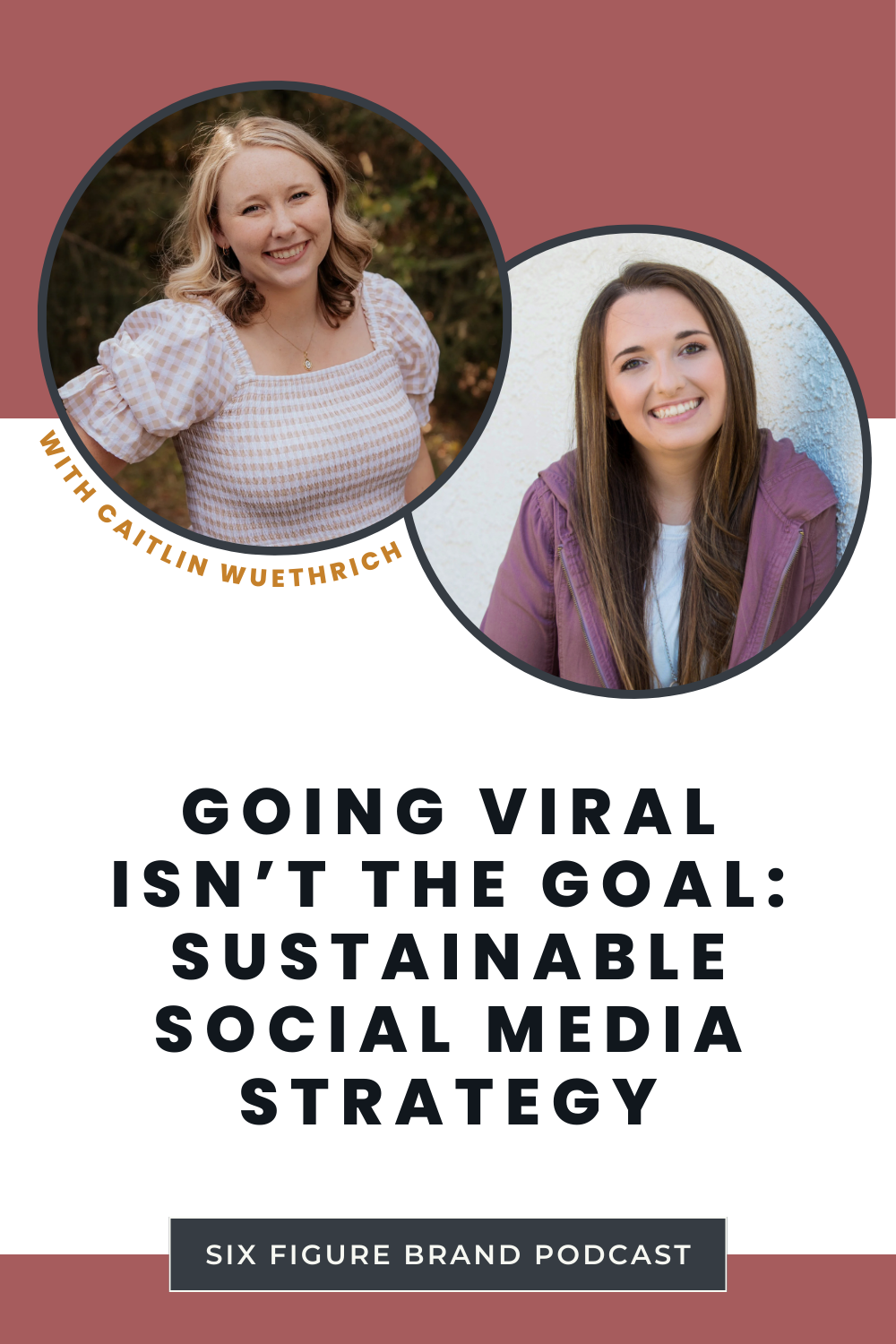
Today I'm sitting down with Caitlin Wuethrich, founder of Caitlin Wuethrich Media, a social media consultancy built on strategy, storytelling, and heart. Caitlin built her business without going viral, without chasing a massive follower count, and without spending all day glued to her phone, all while navigating two high-risk pregnancies and life at home with two babies under two. We're getting into what actually makes social media work, how to build real relationships online that convert to revenue, and what to do when you're showing up consistently but nothing seems to be happening.
Or listen on your favorite platform: Spotify | Apple Podcasts | Amazon Music | YouTube
Caitlin's Story: From Nonprofit Hustle to Intentional Business
Caitlin's background is in nonprofit work, and she loved the mission. But the hours were brutal. She once spent two full days sleeping at the office during a December program push without going home, and she knew it wasn't sustainable long-term. When she found out she was pregnant with her daughter, she made the decision to build something different.
What she took with her from nonprofit was a deep love of connecting with people, particularly through social media. She built her consultancy around that and four years later, with around 1,000 followers on Instagram, she has a six-figure business to show for it.
That detail, 1,000 followers and six figures, is kind of the whole point.
Small Following, Real Revenue: Why Follower Count Is the Wrong Metric
Caitlin doesn't measure success by follower count, and she doesn't chase virality. In fact, when something she posted went viral this year, she took it down because it wasn't aligned with what she was trying to build.
Her entire approach is built on intentionality: getting the right eyes on your content rather than just a lot of eyes. Because a massive audience that isn't full of potential clients isn't going to pay your bills.
"What I am all about with strategy is not just getting a bunch of people having eyes on what you're doing, but getting the right people so that it actually converts to revenue and real relationships."
This tracks directly with the brand strategy work I do with clients. A big audience of the wrong people is just a lot of noise. The goal is always quality over quantity, whether we're talking about brand positioning or your Instagram following.
Social Media Should Work for Your Life, Not Against It
One thing Caitlin talks about a lot is the mental health side of social media, and it comes through in how she structures her approach for clients. She's well aware of the growing "brick" trend, where people are literally blocking themselves out of their social media apps, and she sees it as a signal worth paying attention to.
Her answer isn't to get off social media entirely. It's to make sure that when you are on it, your time is intentional, strategic, and actually generating revenue. Social media that is taking over your life and not producing results is a strategy problem, not a platform problem.
The Social Media Strategy Session: What It Actually Covers
When someone works with Caitlin, the process starts with a deep-dive strategy session that covers several things: a full audit of what's working and what isn't, a review of bios to make sure they're actually directing people toward the action you want them to take, a look at content performance and how the audience is responding, content pillars and ideas, and the practical questions like whether to use hashtags or lean into SEO keywords.
All of that gets delivered in a one-hour call with a takeaway package the client keeps. The goal is to take the "I have to figure this all out myself" weight off your plate and replace it with a clear, actionable roadmap.
For clients on retainer, Caitlin tracks ongoing analytics, looking at conversion rates, website traffic, and for her nonprofit clients, things like donation rates and event attendance that can be traced back to social media activity.
The Invisible ROI Problem
One of the trickiest things about social media is that the return isn't always obvious or immediate. People may be watching you consistently for months, never liking or commenting on a single post, and then show up one day ready to book. Caitlin calls these "lurkers," and they are far more common than most people realize.
Her own sister-in-law, who lives across the country and never interacts with her content publicly, recently told her she's been watching her business grow in real time through her Instagram and congratulated her on recent milestones. Caitlin had no idea she was even paying attention.
"How many people are doing this? I hear this from my clients all the time. They get people out of the woodwork because people are watching."
The practical takeaway here is to add a simple "how did you find me?" field to your intake form or call booking link. It takes about thirty seconds to set up and can give you real data on where your clients are actually coming from over time.
How to Use Multiple Platforms Without Reinventing the Wheel
Caitlin works across Facebook, Instagram, LinkedIn, and even TikTok, which she'll be the first to admit is not her deepest area of expertise. For clients who want support across multiple platforms, her approach is consistent: the core message and offerings stay the same, but the presentation adapts to each audience.
LinkedIn tends to be more formal, more word-heavy, and populated by business owners specifically. Instagram is a little more visual and relaxed. Threads, as I've found in my own experience, is where the real and unfiltered stuff tends to live. The meat and potatoes of what you're communicating doesn't change from platform to platform. What changes is how it looks and how it's framed.
For service providers who feel like they need to completely recreate their content for every platform, this is reassuring. You don't. You need to understand who is on each platform and meet them where they are.
And if you are already posting on Instagram and you have been ignoring Facebook entirely, Caitlin's quick take is to just connect the two accounts and let your Instagram content cross-post automatically. It's not an extra lift and it helps your name show up in more places, which increasingly matters for SEO and AI search results.
Consistency Beats Perfection for Brand Recognition
This is something I feel strongly about from the design side, and Caitlin approaches it the same way from a social media strategy perspective. Constantly changing your colors, fonts, and visual style with every post makes it nearly impossible to build brand recognition.
Think about the accounts you follow where you can immediately tell it's them from a thumbnail before you've even read the name. That recognition is not an accident. It's the result of consistent, repeated visual identity over time.
Caitlin recommends setting up your brand in Canva, committing to a set of templates, and sticking with them. If you have the budget, adding a designer to your social media strategy process to create a custom template library is worth it. If you are DIYing it, a Pinterest mood board is a genuinely useful starting point for getting clear on your brand before you open Canva.
And to be clear: a consistent brand that is 85% what you want is more valuable than a brand that is constantly changing in pursuit of perfect. Consistency builds recognition. Recognition builds trust. Trust builds revenue.
Why You're Getting Engagement But Not Clients on Instagram
If your posts are getting likes and kind comments from your business friends but nobody is actually booking, this section is for you.
Caitlin uses a simple rule: 80% education, 20% sales. Most people who are not converting from social media have that ratio flipped, or are posting almost entirely educational content with very little that actually invites someone to hire them. People follow you because they want to learn from you for free, and they will stay for the great content. But you still have to ask for the sale.
Within that framework, Caitlin structures her own social media feed around a simplified sales funnel: attract, relate, convert. Every week, her content moves through all three of those stages. The stories are where she lives in real time and shows behind the scenes. The feed is where she is being strategic about that funnel.
If you are getting engagement but not clients, the honest question to ask yourself is: when did I last post something that actually asked someone to book me or buy from me?
One Trap to Avoid: Creating Content for DIYers
This is something I had to learn the hard way, and Caitlin avoids it deliberately. If your content is teaching people how to do your job themselves, you are attracting people who want to DIY, not people who want to hire you.
The 80% education principle does not mean posting step-by-step tutorials. It means sharing content that is genuinely valuable to your ideal paying client. Caitlin starts with the end goal: her ideal client booking and paying the invoice. Then she works backward from there to figure out what that person actually wants to know, not how to do her job themselves, but how to get results more efficiently, how to think about the problem differently, or what to do today while they are in the process of hiring her.
A good shortcut: go back through your discovery calls or client kickoff notes. The questions people ask you in those conversations are content ideas. You are already sitting on a goldmine of exactly what your ideal clients want to hear.
When Is It Time to Hire a Social Media Manager?
Caitlin offers different tiers of support, from a single strategy session for the person who wants to manage things themselves but needs a clear plan, to full management for the person who is ready to hand it off entirely.
Her honest answer on when to hire: if you are stressed out by social media and not getting leads from it, it is time to invest in some kind of support. Whether that's a one-time strategy session or ongoing management depends on your budget and capacity, but doing nothing and hoping it gets better on its own is not a strategy.
The other thing worth preparing before you bring in support? Your mindset. Caitlin has worked with clients who have incredible businesses but show up to the relationship feeling self-conscious about putting themselves out there. That hesitation will limit what a social media manager can do for you. If you hire someone to manage your social media and then are too nervous to post the reel they filmed with you, you're leaving a lot of value on the table.
Get your brand strategy locked down, get clear on your visuals, and then give yourself permission to show up as you are. That combination is what makes the investment pay off.
Social Media Does Work Service Providers
Social media works. It just doesn't work the way most people are approaching it.
It is not about going viral. It is not about having the biggest following. It is not about being on every platform or posting every single day. It is about being strategic, being consistent, and building real relationships with the right people over time. That is a slower process than an ad campaign, but it is also what builds the kind of trust and recognition that leads to long-term, sustainable client relationships.
As Caitlin puts it: once her clients understand that social media is a relationship-building tool and not a vending machine, everything shifts.
🔗 Links & Resources Mentioned In The Episode:
➡️ Visit Caitlin's Website
➡️ Follow Caitlin on Instagram @caitlinwuethrichmedia
➡️ Follow me on Instagram @spechtand.co
🎧 Listen to episode 65 of The Six Figure Brand Podcast on Spotify, Apple Podcasts, Amazon Music, and YouTube
