
Your Brand Isn’t All About You. But It Isn’t All About Your Ideal Client, Either.
Should your brand feel completely, unmistakably like you? Yes.
Should every decision you make about your brand be based on what will resonate with your ideal client? Also yes.
Seriously though, if you’ve spent any amount of time looking for branding advice online, you’ve probably heard convincing arguments for both.
On one side, there’s the personal branding camp: You are the differentiator. No one else has your exact personality, story, opinions, preferences, or way of doing things. So if you want to stand out, your brand needs to be built around you.
On the other side, there’s the ideal-client camp: Your brand is about your audience. If you want your brand to attract clients and grow your business, your messaging, visuals, and strategy need to be based on what your ideal clients want and need.
So at the end of the day, which one is right?
The real answer is both and neither.
Your brand shouldn’t be entirely about you or entirely about your ideal client.
Your brand is really about the relationship between the two.
A strong brand needs to feel authentic enough that you actually enjoy using it, marketing with it, and being associated with it. But it also needs to help the right clients recognize themselves, understand your value, trust you, and feel confident hiring you.
Finding the sweet spot between those two things can give you a brand that feels good to use and helps grow your business.
So let’s talk about why it’s so easy to end up on one end of the spectrum, what happens when you do, and how to build your brand in the sweet spot where you and your ideal client meet.
Why is there so much conflicting advice about who your brand is really for?
There’s a reason this question gets confusing so quickly… because both sides make a pretty compelling argument.
With the rise of the influencer, personal branding has become incredibly prevalent in the online business world. And it makes sense.
When there are hundreds (or thousands) of people offering services similar to yours, you are an important part of what differentiates your business.
No one else has your exact combination of personality, experience, story, values, opinions, approach, and perspective.
So it’s easy to hear “you are the differentiator” and conclude that your brand should revolve around you.
But then there’s the traditional marketing advice that has told business owners for years: “Your brand isn’t about you. It’s about your customer.”
That advice makes a lot of sense, too.
After all, you’re building a business. If you want people to hire you, you need to understand what they want, what problems they’re trying to solve, what they need to hear, and what will help them trust you enough to open their wallet.
There are smart, talented branding professionals advocating for both approaches, and neither side is completely wrong.
The real problem is treating it as an “either, or” answer.
What happens when your brand goes too far in either direction?
I see this happen often when business owners DIY their brands, or even when they work with a designer who understands aesthetics but doesn’t take a strategic approach to branding.
They end up falling too far to one side.
And which side they choose creates a different set of problems.
When your brand becomes too much about you
Maybe you’ve created a brand that you absolutely love.
It uses your favorite colors. It captures your personality perfectly. Your website is full of your story, your opinions, your interests, and all the little things that make you you.
But when a potential client lands on it, they’re left wondering:
→ What does this mean for ME?→ Is this service going to solve my problems?→ Will I see an ROI from my investment?→ Why should I hire this person?
Your brand can feel deeply authentic to you without effectively communicating your expertise or giving someone a reason to buy.
If this is the case, you might attract followers who like your personality, enjoy your content, or think your brand is beautiful (which we love!) but liking you and hiring you aren’t necessarily the same thing.
And that can leave you wondering why you invested so much time, energy, or money into creating a brand that isn’t translating into the clients or business growth you expected.
When your brand becomes too much about your ideal client
Doing the opposite can cause problems, too.
You’ve done the research. You know your ideal client. You’ve chosen the words they’re supposed to respond to, created the visuals that will appeal to them, and checked all the strategic boxes.
On paper, your brand makes perfect sense… but it doesn’t quite feel like you.
Maybe the messaging sounds like something you’re supposed to say rather than something you would actually say.
Or the visuals appeal to your target audience, but you don’t feel excited to use them.
Or maybe you find yourself procrastinating on marketing because showing up with your brand feels like stepping into a costume rather than putting on your favorite pair of jeans.
Another problem with focusing your brand too much on your ideal client is that you can start to attract people who technically fit your ideal-client profile but aren’t necessarily people you enjoy working with.
This happens because your brand hasn’t given them enough information to figure out whether you’re a personality fit for them, either.
That’s why the answer isn’t choosing the “right” side of this argument… it’s finding the overlap.
Your brand is the relationship between you and your ideal client
So if your brand isn’t supposed to be entirely about you or entirely about your ideal client, what should it be about?
The relationship between the two of you.
Think of your brand like this:
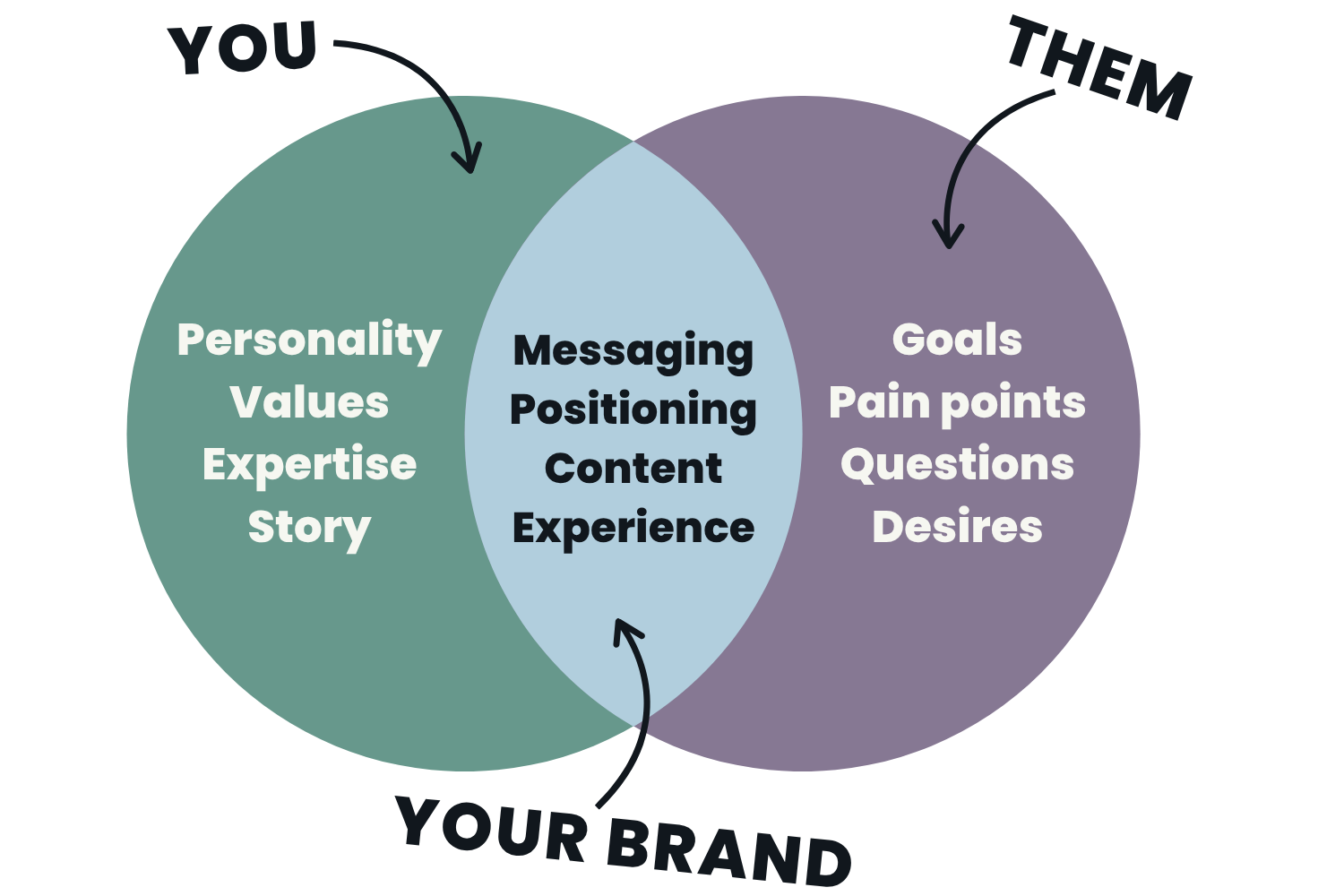
On one side, there’s you: your personality, values, expertise, story, and all the things that shape how you naturally show up in your business.
On the other side, there’s them: your ideal clients’ goals, pain points, questions, desires, and what they need from you in order to understand your value and feel confident hiring you.
But your brand doesn’t live entirely inside either circle. It lives in the overlap.
That’s where who you are meets what they need. And where things like your messaging, positioning, content, and client experience can connect the two.
Your personality helps the right clients get a feel for who you are, how you work, and whether you’re someone they’ll enjoy working with.
Your expertise becomes most powerful when you connect it to the problems your clients need solved and the goals they want to reach.
Your story can help ideal clients understand your perspective, connect with your approach, and see why you might be the right person to help them.
And your messaging brings your voice and perspective together with the language, questions, and concerns that matter to your ideal clients.
That overlap is your branding sweet spot 🍭
And contrary to popular belief, finding it doesn’t require watering yourself down to appeal to more people or manufacturing a bigger, louder version of your personality so you can stand out.
It means being intentional about which parts of you are most relevant to the people you want to work with and how you use those things to communicate, connect, and build trust.
That’s what great brand strategy does.
It finds the overlap and brings it to life through your messaging, visuals, website, marketing, content, and the experience people have with your business.
The result is a brand that feels genuinely like you AND strategically connects with the people you most want to reach.
You can communicate naturally instead of constantly wondering how you’re “supposed” to sound and differentiate yourself without creating a carefully manufactured persona.
And your potential clients get enough of you to decide not only whether you can help them, but whether you’re the person they actually want helping them.
That’s how you end up with a brand that feels good to show up in and does its job of connecting you with the right people.
How to find the overlap in your own brand
If you’re realizing your brand might be living a little too far inside one of those circles, it doesn’t mean you need to throw everything out and start over.
Start by auditing your brand from both perspectives.
First, look at it from your POV.
Ask yourself:
Does this brand actually feel like me?
What do I genuinely love about it?
What would I never want to change?
What feels outdated or misaligned?
What are my non-negotiables when it comes to my values, voice, messaging, and visuals?
What do I want to be known for?
Then switch perspectives and look at your brand through your ideal client’s eyes.
Ask yourself:
Does my brand clearly speak to the clients I want to attract now?
What do those clients need to feel before they’ll trust me?
How do they describe the problems I solve?
What feedback have they given me about my brand?
What do they need to see or understand before they’ll feel confident hiring me?
Then start looking for the overlap.
→ Which parts of your brand do you genuinely love and your ideal clients respond strongly to?
→ Where might something that no longer feels like you also be creating confusion or disconnect for potential clients?
→ Where are you sacrificing something important to you because you think your ideal client wants it?
→ Where are you prioritizing your own preferences even though they may be getting in the way of communicating clearly?
This is also where market research becomes incredibly important.
One of the most powerful things you can do is actually talk to your ideal clients. (Crazy concept, I know.)
Market research interviews give you the chance to ask deeper questions, follow up on interesting answers, and hear (in your clients’ own words) how they think about their problems, what they want, what they’re worried about, and what ultimately helps them feel ready to invest.
But interviews aren’t the only place you can find those insights! Chances are, your clients have already told you a lot… you just need to know where to look.
Dig through your client intake forms, inquiry forms, testimonials, feedback surveys, discovery call recordings, sales call notes, emails, DMs, and even questions clients have asked during your work together.
Turn What You’ve Learned Into a Clear Brand Strategy
Once you’ve looked at your brand from both perspectives and dug into what your clients are actually telling you, you’ll probably start to see some patterns.
You may notice parts of your brand that feel completely aligned with who you are and resonate with the people you want to reach. You may also spot places where something feels off, where your messaging could be clearer, or where the way you’re showing up no longer reflects the business you’re building.
The next step is figuring out what to do with all of that information.
That’s where brand strategy comes in.
It helps you take what you know about yourself, your business, and your ideal clients and turn it into intentional decisions about what you want to be known for, how you position yourself, what you communicate, and how your brand should feel when someone encounters it.
And if you want help making sense of all those pieces and figuring out where your own branding sweet spot lies, that’s exactly the work we do together inside a Stand Out Brand® Strategy Session.
We look at who you are, what you want to be known for, what feels authentic to you, and where you want your business to go. Then we bring in what you know about the people you want to reach — what they care about, what they’re struggling with, what they need to understand, and what helps them feel confident choosing you.
From there, we find the overlap and use it to create a clear strategic direction for your brand.
That clarity makes so many other parts of your business easier.
You can show up and market your business in a way that feels natural to you. Your potential clients can more quickly understand your expertise, your value, and what it might be like to work with you. And the people who are drawn in are more likely to be a fit for your services and for the kind of client relationships you want to have.
Ultimately, you’re creating a brand that feels genuinely like you, connects with the people you most want to work with, and gives you a stronger foundation for growing your business.
“Okay…but exactly how much should my brand be about me versus my ideal client?”
I wish I could hand you a perfect formula… but it just doesn’t exist.
Your brand doesn’t necessarily need to be exactly 50% you and 50% your ideal client.
For one business, the right balance might be closer to 60/40. For another, it might be 70/30.
The right blend depends on your business model, your industry, your audience, and how closely you are tied to the service you’re selling.
Unless you’re an influencer, celebrity, or someone whose actual product is essentially their personality, though, you probably shouldn’t be 100% in either camp.
But there is a deeper reason we tend to gravitate toward those extremes: Extremes are easier.
Making everything about yourself can allow you to skip the uncomfortable work of truly understanding your audience.
Making everything about your ideal client can allow you to hide behind strategy and avoid the vulnerability that comes with putting your actual personality, opinions, and perspective into your brand.
Building in the middle asks you to do both, and requires strategy and vulnerability.
That can feel much harder.
But it’s also where you create a brand that people can genuinely connect with, that you enjoy showing up in, and that can truly support the growth of your business.
Your brand doesn't have to choose a side
To reiterate: your brand isn’t all about you, and it isn’t all about your ideal client either.
You need enough of yourself in your brand that it feels genuine, sustainable, and comfortable to use.
And you need enough understanding of your ideal client that your brand clearly communicates your value, builds trust, and helps the right people recognize that you can help them.
There’s no universal formula for exactly where those two things should meet.
Instead, your goal should be to make sure your brand isn’t living entirely inside one circle.
When you find that overlap, you can build a brand that feels like you and works for your business.
A brand you actually want to show up in.
A brand that helps the right people understand your value.
And a brand that attracts clients who genuinely connect with you and the way you work.
Because ultimately, your brand should serve as the bridge between you and the people you’re here to help.
Ready to Find the Sweet Spot Between You and Your Ideal Client?
You could keep trying to figure out whether your brand should be more about you or more about the people you want to attract.
Or we can figure out what the right balance looks like for your business.
Inside a Stand Out Brand® Strategy Session, we’ll look at both sides of your brand: who you are, what you want to be known for, and what feels authentic to you alongside who you want to attract, what they need from your brand, and what will help them understand your value and trust you enough to hire you.
Then, we’ll find the overlap and turn it into a clear strategic direction for your brand.
So instead of wondering whether your brand is too much you or not enough you, you’ll have a strategy that helps you:
Build a brand that feels natural to show up in (not like a persona you have to perform)
Clearly communicate your expertise and the value of working with you
Give potential clients a genuine sense of who you are and what it’s like to work with you
Attract people who are a fit for your services and the kind of people you actually enjoy working with
Make confident decisions about your messaging, visuals, website, and marketing based on strategy instead of guesswork
No more trying to choose between building a brand that feels like you and building one that appeals to your ideal clients.
Let’s build the bridge between the two, together.
