
Ep. 49 Building Community in a Disconnected Online World with Kelsey Green
In today's online business world, community is more important than ever and somehow also harder to build than ever.
I sat down with Kelsey Green, a community builder, facilitator, and former Specht & Co. client, to talk about what real, meaningful community actually looks like beyond algorithms, likes, and performative "connection."
We're diving into circles of community rooted in trust, alignment, and belonging. The kind that support you through transitions, deepen your relationships, and help you feel less alone as a business owner.
Kelsey also shared her experience rebranding with Specht & Co. and why that process was not only strategic but also deeply emotional and transformative. This conversation lives at the intersection of community, branding, mental health, and learning how to take better care of ourselves while building businesses that actually support our lives.
Or listen on your favorite platform: Spotify | Apple Podcasts | Amazon Music | YouTube
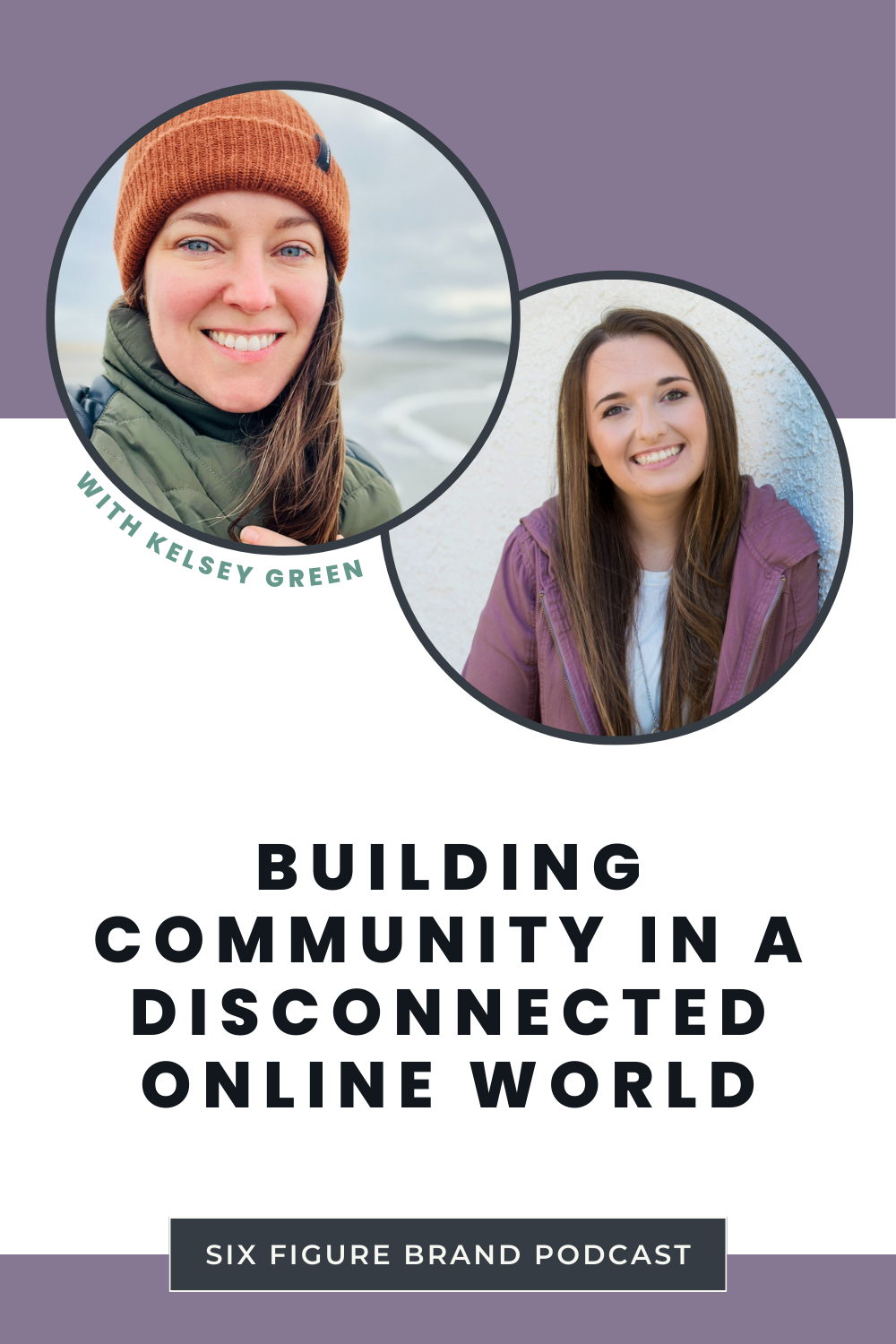
Meet Kelsey Green
Kelsey currently works with different groups of people, primarily women, focusing on community building and hosting things like masterminds. She also walks people through a digital course called "How to Build Your Circle" about in-person community.
But her journey to this work wasn't linear.
From Environmental Conservation to Community Building
Kelsey's background is in communications and environmental conservation. She worked as a scientist out in the field before transitioning to work focused on how people interact, community, communications, and outreach.
Then came the nonprofit space, which eventually led to a reckoning many of us can relate to.
"I was doing great work with great people in the environmental conservation space, but really hit a pretty serious rock bottom with burnout because the pay was so low," Kelsey shares. "I was actually running a side business at the same time, which did serve me well in the long term. But at the time, it was very challenging. And then it was COVID. I was in a toxic relationship. I needed major surgery. It was really just coming to this place of reckoning where you hit one of those rock bottoms in your career and your life and you need to do a little redirect."
Most of us have experienced a reckoning like this in some form. For me, it was having my kids. For many people, it's when they finally decide to leave that nine-to-five. That moment when you realize something fundamental has to change.
Now Kelsey still does work with clients in a communications capacity, but her focus is on working with groups of women and speaking about topics like digital minimalism and in-person community.
The Emotional Side of Branding
Before we dive into community building, I want to share Kelsey's branding experience because it's such a powerful example of how brand strategy work can be transformative beyond just getting pretty visuals.
We worked together on a branding project coming up on two years ago now. Kelsey came to me even though she has extensive knowledge in branding and could qualify as a brand strategist herself.
"The cobbler's kid never has any shoes," Kelsey laughs. "I was working with various clients and helping them through their branding processes. I'm not a designer, so that is one of the reasons I came to you. I would help clients get something going pretty quickly and not get stalled on deciding on the logo for a year."
Why She Chose Specht & Co.
"You are so highly recommended within our circles and I loved your work," Kelsey explains. "You also seem able to create different kinds of branding for different kinds of people. I feel like sometimes designers have a very distinct style, but you really could pull out the essence of the client and create for that."
I definitely don't have one signature style, which is both a blessing and a curse. I can't position myself as "the designer for feminine whimsical brands." But I am the designer who can make whatever you need it to be and weave in that strategy piece so we're not just making a pretty brand.
Working with Kelsey was particularly collaborative because she understood brand strategy so well. We could move faster and dig deeper than with someone brand new to these concepts.
The Unexpected Emotional Journey
Even having done brand strategy work herself and walked clients through the process, Kelsey wasn't expecting the emotional impact of her own branding journey.
"I honestly thought it was going to be a very pragmatic process," she admits. "We started, had a ton of fun throughout. And then my long-term relationship ended in the middle of that branding process."
The branding process became an anchor during an incredibly difficult time.
"It's so personal, the branding. It's emotional. Because of all these in-depth questions you're asking, it really is a process to go through what it is that you are trying to bring into the world and your intentions."
They wrapped up the process as the breakup was happening. Kelsey remembers creating her brand launch and all her social media posts "with an absolutely destroyed broken heart."
"It was literally the one little light that was happening at that moment. And when I launched and put the brand out live, I got such incredible feedback from people. That was such a wonderful thing to experience in that super dark time."
The Lesson in Letting People Support You
This story is such a powerful lesson in letting people support us. It would have been easy for Kelsey to pause the project and say she had life stuff going on. And I would have agreed.
But then she would have sat with her broken heart and probably stretched out the healing process. The project might have become this huge mountain she never came back to tackle.
Instead, she let the branding process be a source of light. She used it to get introspective and think about who she is, what she cares about, and what she's trying to do after going through a major life transition.
Then when she launched, people showed up with love and encouragement.
You have to give people the opportunity to love on you. And that only happens by putting yourself out there.
Leverage Your Brand Launch
"People are pumped about branding," Kelsey says. "I will spend so long helping someone decide between options or supporting them through the branding process. Even if it's someone I've never met, it's exciting."
Her friends who knew she was going through a hard time showed up even harder. One even messaged her: "I can't believe you're actually doing this right now."
"You only do branding or rebrands every so often," Kelsey points out. "So leverage the absolute crap out of it."
Why Community Feels Harder Than Ever
Now let's address why we're really here: building authentic community in an increasingly disconnected world.
"I got into business to work for myself, but not by myself," Kelsey says. "That can happen so often, especially if you're in the digital space. You're an online entrepreneur working by yourself in your living room or at your kitchen table. It can feel so freaking lonely."
But this isn't just an online business problem. This is a human problem affecting all of us.
The Data on Isolation
"Honestly, just in life, for whoever we are and whatever kind of work we're doing, the data is becoming very clear that with the rise of the smartphone and streaming platforms, we are becoming more isolated in general, more siloed. With that, we're seeing a lot of mental health struggles and physical health struggles that can happen from isolation and loneliness. This is only going to become more of an issue as we have more technology."
Kelsey grew up as an only child with a single mom, and they moved around frequently. She learned some very adaptive strategies for making friends quickly, some rooted in trauma, but strategies that have served her both professionally in PR and communications and personally in life.
"I've just always invested in groups and in people, and this is becoming more important to me. I don't have kids, and looking at the ways that our relationships feed us and fuel us and support us through our lives, we can really fall into these little silos where we only hang out with the parents of our kids' friends or only with our work friends."
Building a thriving community of actual people, physical people around us, is critical.
Building Community the Right Way
Most of my business comes from referrals. How do I get those? By making friends who are also business owners. But you have to do it genuinely.
I can't enter networking groups (whether in person or online) thinking "I'm here to get 10 referrals this month." It has to come from a place of genuinely wanting to meet people, connect with them, and find out some commonality that we can keep coming back to.
If a new client comes from that connection in some roundabout way? Great. If not? The value is the community itself.
Networking Without Burning Out
"It is interesting and challenging as a business owner," Kelsey acknowledges. "If you just want referral-type scenarios, you can join BNI or similar groups. But for actual connection, you can do business and have friendship, mutual respect, and understanding. Those things are not mutually exclusive."
I've definitely fallen into the trap of returning from maternity leave, joining multiple networking groups, scheduling 30 coffee chats on my calendar, getting excited about it, and then watching it become just another task. I would get on a call and think, "Wait, who is this person and what are we supposed to talk about?" Then I would feel terrible about it.
The other trap? Finding a group you really connect with and thinking, "Okay, I have a community now, I'm done." You never reach outside of that single group.
In business, what can happen is you eventually connect with all 200 people in that networking group. They've all made the referrals they're going to make, the ones who were going to hire you have hired you, and then what? If that's your main source of business, the well has dried up.
It's about balance. Not forcing it by booking 10 calls a week, but also not getting too comfortable in one group.
"I have absolutely done that strategy of wanting to meet as many people as possible and then booking everything and showing up not fully present," Kelsey admits. "We can't always be 100% rested, hydrated, and fully present for every conversation. But if you're trying to do a sheer numbers approach, that's not the way."
Intention Matters
If your intention is not genuine connection, regardless of whether they're a good fit for what you offer, people can sense that inauthenticity.
The Screen Time Problem for Online Business Owners
Here's where things get really interesting. As online business owners, we're in a unique position. Our business requires screens. But those same screens are also causing much of the isolation and disconnection we're trying to solve through community.
"These companies have created these devices to be super addictive, using the same mechanisms as slot machines," Kelsey explains. "Everyone should give themselves a little bit of grace. We're basically holding a hyper-addictive device in our hands."
As we have moments of boredom and reach for our phones, that neural pathway becomes more and more concrete until that's just what we're doing constantly. Then we really can't handle any moments of boredom or silence.
When You Can't Focus Anymore
"I was not able to focus anymore. Full stop. I felt like I couldn't concentrate on things I was doing, especially big deep work projects or tasks."
The research is clear: when we check notifications repeatedly throughout the day, it increases the probability that we won't be able to focus on tasks. Our brains become accustomed to this fractured attention. Our dopamine levels are impacted.
Simple Changes That Make a Huge Difference
Put your phone out of sight. Research called "The Brain Drain" shows that if your phone is in sight, even face down, even if it's someone else's phone, you are less able to focus and less present.
Silence your notifications. If you have kids or aging parents and need certain calls to come through, you can configure those settings specifically.
Get off your phone as you approach bedtime. Kelsey's goal (though it doesn't happen every night) is 7 p.m. to 7 a.m. with no phone. It stays in her closet with the ringer on extra loud for emergencies only.
"This has changed my sleep life. I can't even tell you. I used to think I was an insomniac and that I was just a bad sleeper. But I was drinking wine at night, watching Netflix, and scrolling my phone until who knows when, then trying to go right to sleep. It's just terrible."
The Data Doesn't Lie
I wear a Garmin watch that gives me a sleep score every night. It's usually lower than I'd like because I have two kids who wake me up throughout the night. But the difference is stark: on nights when I put my phone away even just an hour before bedtime versus being on it right up until bed, there's a 10 to 15 point difference in my score.
Having quantifiable data is helpful because otherwise I tell myself it's probably just a placebo effect. But no, there are measurable physiological changes happening in my body that demonstrate this makes a real difference.
Finding Time for What Matters
Kelsey tries to be phone-free from 7 p.m. to 7 a.m. She's not going to bed at 7 p.m. That means she has three to five hours at night to do something that actually serves her, whether that's taking a bath, doing a puzzle, reading a book, or connecting with a friend.
We often tell ourselves, "I don't have time for hobbies." But that's not accurate. We do have time. We're just spending that time doing something else.
It's like when someone says "I don't have the money." Sometimes what they're actually saying is "It's just not a priority for me right now." And that's fine. But we should be honest about it.
Same with time. Sometimes we legitimately don't have time. But sometimes we would simply rather spend that time on social media.
High-Quality Leisure Matters
"For Screen Free Sunday challenges that I run, I do a survey and almost always people say, 'Wow, I have a lot more time than I thought I did. There are a lot more hours in the day than I realized,'" Kelsey shares.
Cal Newport's book "Digital Minimalism" discusses replacing scrolling and streaming with high-quality hobbies. Things you do with your hands. Activities like connecting with people, joining a book club, volunteering, or service work.
Here's the counterintuitive part: You think you're tired. You feel like you just need rest, so you want to zone out. You assume it will be restful for your brain to scroll or stream because you can get into that zoned-out state.
But your brain is actually processing significant amounts of information when you're scrolling. Even though you're lying there in this zombified state, your brain is still doing substantial work.
This creates a negative feedback loop where you become more tired, which makes you feel like you need more rest, so you scroll more, which makes you more tired.
If you replaced it with something like woodworking, gardening, or even just reading (you can still consume content, but at a different pace), you would feel more rested, grounded, and ready to engage with life.
For a while, my husband and I got really into Legos. When I'm building Legos or baking or doing something hands-on, I can't look at my phone. Initially, that was almost accidental, but then I realized: wow, I just went three hours without looking at my phone and I feel rejuvenated. I feel like I've used my brain in a different way and I'm ready to go do something productive now.
The Cold Turkey Problem
Food addiction is one of the hardest addictions to overcome because you can't go cold turkey. You can't stop eating. Similarly with screens, we don't live in a time where it's realistic to completely eliminate screens.
I can't even fly anymore without digital boarding passes. We certainly can't run our online businesses without screens.
"This is even more of an argument for why we need to put those boundaries in place and why we need to work hard to manage them," Kelsey says.
The Business Excuse
"It's easy to concede all of your autonomy to the digital space because you have a business. I think this is kind of a lazy way to approach it. If you can't step away from your business for a Sunday, your business is running you. You are not running your business."
Just because you need to do some work online doesn't mean you need to be doing everything online all the time.
"I don't know how many times I've opened Instagram just to post a piece of content. All I need to do is post, share a few stories, do some engagement, and get off. Two hours later, I've done that initial task and then I'm deep into researching the best restaurants in New York City. I'm not even planning a trip to New York City."
Procrastiworking
I call this phenomenon "procrastin'working." You tell yourself, "I have to engage on social media." That's why I set a screen time reminder on my phone.
With two young children, I have very limited work time. My daughter attends preschool for a couple hours in the mornings, my son is still home with me, so I have his nap time and that's essentially it.
I would hear him wake up from his nap and realize: yes, I scheduled some content for my business (which is legitimate work), but then I wasted all the remaining time scrolling on Instagram or Threads when I have actual client work that needs to be completed.
What are the activities that are really moving the needle in your business? They might require a computer, but they might not require the internet or social media at all.
You tell yourself it's productive. And to some degree, it is. But is it the best use of your limited time? Probably not.
Your brain still feels exhausted and depleted after all that digital busy work, just the same as if you had been doing focused deep work.
Screen Free Sundays
Kelsey runs Screen Free Sunday challenges once or twice a month. Honestly, 24 hours is proving difficult for many people, which is completely understandable. So she's creating a starter kit for setting digital boundaries using a baby-step approach.
The 24-hour challenges will continue because people who have been able to complete them (or even 12 hours) have found them remarkably useful.
"You do need to replace that screen time with something," Kelsey emphasizes. "If you're just trying to cut it out and there's a big void, that's going to be tough. But replacing it with things that we used to do before we were all on these devices is really helpful."
She's developing more analog activities people can build into their lives in 2026, because filling that void with meaningful activities is essential for success.
Creating Healthy Relationships with Technology
For parents (and this is something Kelsey and I discussed even though she doesn't have children), navigating screen time is particularly complicated.
Yes, my kids get screen time. We'll see how that affects them when they're adults. But it has been challenging for me to navigate this. I would love to be a screen-free family, but the reality is they're growing up in a world where they will be surrounded by screens for the rest of their lives. I want them to know how to navigate that reality.
I have friends who maintain strict no-screen-time policies with their families. When they're at the doctor's office and there's a TV playing, they cannot pull their kids away from that screen. Even if it's just a commercial or something not intended for children, the kids are mesmerized.
My daughter watches TV basically when she wants to. She has a tablet she plays games on. We try to maintain some parameters around usage since she's only three. But when I tell her, "Hey, it's time to turn the tablet off, we're going to go to the park," she responds, "Okay, mommy" and moves on.
We get scared about screen time and think we need to have zero tolerance or prevent our kids from having any access ever. But as Kelsey said regarding digital minimalism, it's really more about creating a healthy relationship with screens than cutting yourself off entirely.
For adults, Cal Newport's "Digital Minimalism" offers an excellent framework: ensure your use of technology supports your core values. Develop an ethos around it. Put boundaries in place and work diligently to manage them.
Kelsey also recommends "The Anxious Generation" by Jonathan Haidt as one of the best resources on parenting in the digital age, especially as kids get older. "It scared me and I don't even have kids," she admits.
The Bottom Line
Building community in a disconnected online world requires intentionality. It means:
Showing up genuinely for connection, not just for referrals or transactions
Setting boundaries with technology so you have time and mental space for real relationships
Replacing scrolling with high-quality leisure that actually restores and energizes you
Letting people support you and being vulnerable enough to receive that support
Understanding that your business should support your life, not control or consume it
As Kelsey said, we got into business to work for ourselves, but not by ourselves. That requires actively building and maintaining community, both online and in person.
It requires putting the phone down, showing up in real life, and doing the sometimes uncomfortable work of connecting with actual humans beyond likes and comments.
But the payoff? A business and a life that feel sustainable, supported, and significantly less lonely.
The work of building real community and creating healthy boundaries with technology isn't easy. These devices are designed to be addictive. The algorithms are engineered to keep us scrolling. The dopamine hits are intentional.
But when we make the conscious choice to prioritize genuine human connection over digital engagement, to replace mindless scrolling with meaningful activities, and to let our businesses serve our lives rather than consume them, we create something far more valuable than any metric could measure.
We create lives worth living and businesses worth building.
🔗 Links & Resources Mentioned In The Episode:
➡️ Connect with Kelsey on Instagram
➡️ Visit Kelsey's Website
➡️ Join the next Screen Free Sunday Challenge
➡️ Follow Morgan on Instagram @spechtand.co
➡️ Grab The Stand Out Brand Foundations Workbook
➡️ Book Your Stand Out Brand Strategy Session (use code SFBPOD for $100 off)
➡️ Book A Brand Chat
🎧 Listen to episode 49 of The Six Figure Brand Podcast on Spotify, Apple Podcasts, Amazon Music, and YouTube
